El Sistema y Colombia: ¿cuál es el problema?

Hace un mes, el presidente Petro anunció que la primera dama, Verónica Alcocer, y el viceministro de cultura, Jorge Zorro, habían viajado a Venezuela para “ver el sistema orquestal venezolano en música clásica” y que pronto iba a arrancar “el sistema orquestal colombiano.”

Cuando llegué a Venezuela en 2008 para empezar a investigar sobre El Sistema, estaba tan fascinado por este programa orquestal como cualquiera de los que ahora quieren importar su esencia a Colombia. Como tal, puedo empatizar con ellos. Pero durante 15 años de investigación, mi visión de El Sistema ha cambiado radicalmente. Como alguien que desde entonces ha desarrollado una fuerte afinidad con la educación musical y los educadores musicales en Colombia, me siento obligado a compartir lo que he aprendido, con la esperanza de ayudar a evitar un error histórico.

Proponer la “orquesta-escuela” como elemento central de la nueva política musical colombiana es adoptar una jerarquía cultural que contradice directamente tanto la investigación contemporánea como el programa político y cultural más amplio del gobierno. Es muy irónico ver a un Gobierno de Cambio inspirado por una política musical ampliamente cuestionada, concebida hace casi 50 años y con claras raíces en el pensamiento colonial. Es muy extraño ver a un “gobierno de los nadies” proponer una política de “democratización al acceso de los valores de la cultura universal,” una idea que ha sido criticada desde los años 60 por su elitismo.

Es muy importante que una política de esta envergadura se apoye en investigaciones independientes y no sólo en publicidad institucional y propaganda política. El Sistema no se puede entender solo visitando su sede en Caracas, observando sus espectáculos orquestales o contando las masas de músicos de orquesta que ha producido. Estos simplemente reflejan los enormes recursos que se han invertido en él. Lo importante es el rendimiento de esos recursos a nivel social – y las investigaciones plantean muchas dudas.

En el siglo XXI ha surgido todo un campo internacional de investigación sobre la educación musical y el cambio social. Ha criticado el tipo de enfoque ejemplificado por El Sistema, señalando en su lugar modelos muy diferentes, centrados en los recursos culturales locales, la creatividad, la autoexpresión y los conjuntos más pequeños. En 2020 la Sociedad Internacional para la Educación Musical cerró el grupo de interés especial de El Sistema. ¿Por qué los diseñadores de la política musical colombiana no tienen en cuenta estas corrientes contemporáneas?

El objetivo oficial de El Sistema es “rescatar al niño y al joven de una juventud vacía, desorientada y desviada.” Este tipo de visión despectiva de la juventud, centrada en los déficits, fue desterrado hace mucho tiempo del ámbito del desarrollo social, que hoy en día prefiere ver a los jóvenes, en palabras de un libro reciente sobre Medellín, como “un fuego vital.” Consolida una relación jerárquica entre adultos y jóvenes y, al ver a estos últimos como deficientes, les quita poder, autonomía y voz. Esta malsana dinámica está detrás de muchos de los problemas documentados de El Sistema, incluyendo abuso sexual, maltrato a los músicos, inequidad de género, corrupción y abierta politización.

La educación musical que imparte tiene un enfoque anticuado, limitado y disciplinario. Los jóvenes músicos llamaban al fundador de El Sistema, José Antonio Abreu, “el Führer.” Un periodista de investigación lo etiquetó “el ogro filantrópico.” Una evaluación externa en 1997 identificó la dominación, la humillación y el bullying como características de la práctica pedagógica de El Sistema. Este estilo autoritario ha sido muy criticado en las últimas décadas por investigadores de educación musical en todo el mundo por ser excluyente e incluso traumatizante. El Sistema ha producido muchos buenos músicos, pero ¿quién ha contado los fracasos, las heridas y las decepciones?

Hasta la Fundación Hilti, que financia a El Sistema y a aliados cercanos como Iberacademy en Colombia, reconoció hace poco la necesidad de un cambio sistémico en este campo. Hilti creó la Academia para el Impacto a través de la Música con el objetivo de reformar la enseñanza. Su directora se mostró muy crítica con la pedagogía convencional por restringir la capacidad de acción de los estudiantes y la creación de comunidades. Así que los métodos de El Sistema son cuestionados incluso por uno de sus aliados más importantes. Intentar importar esta pedagogía a Colombia en 2023 sería un gran error, más aún teniendo en cuenta que los intentos anteriores de hacerlo han fracasado.

Dadas estas obvias debilidades, no es de extrañar que El Sistema no funcione como programa social. En 2017, el BID, que también financia el programa, publicó la mayor evaluación de El Sistema jamás realizada. Estimó que la tasa de pobreza entre los que se inscribieron en El Sistema era del 17%, mientras que la tasa de pobreza de los estados en los que vivían era del 47%. En otras palabras, el programa parecía excluir a los niños pobres en lugar de incluirlos. El estudio no encontró pruebas de que El Sistema potenciara las habilidades cognitivas o prosociales. Además, reveló una alta tasa de deserción.

Así pues, la idea de rescate no sólo es ideológicamente problemática, sino también una fantasía. Cuando se puso a prueba, los poderes mágicos de El Sistema no aparecieron por ninguna parte. La base de El Sistema es una idealización de la música, no un programa de eficacia demostrada.

Por lo tanto, los educadores musicales colombianos deberían estar preocupados al encontrar el mismo pensamiento subyacente en las nuevas propuestas del gobierno, que afirman que el paradigma orquesta-escuela permite “el rescate de la población juvenil e infantil de los sectores más deprimidos.” Su premisa central es que tocar o cantar en conjuntos grandes representa “un ejercicio de diálogo permanente que conduce a acuerdos. […] Este ejercicio permite el desarrollo de la concertación como principio fundante de la transformación social.” El problema es que el estudio del BID no encontró ningún cambio en las habilidades prosociales de los estudiantes de El Sistema. Además, ¿dónde está esa supuesta transformación social en Venezuela después de 48 años de inversiones masivas? No es de extrañar que no haya pruebas de los cambios sociales deseados: como señalan los destacados educadores musicales André de Quadros y Emilie Amrein, “el ensamble grande dirigido reproduce una cultura arraigada en el monólogo más que en el diálogo.” Una vez más, el modelo dominante se basa en la idealización, no en la realidad ni en la investigación.

Afortunadamente, Colombia viene avanzando en repensar los modelos pedagógicos para los ensambles grandes, a diferencia de El Sistema. La Red de Escuelas de Música de Medellín es un buen ejemplo de este replanteamiento. Empezó en la década de 1990 estrechamente vinculada con El Sistema, pero después se alejó como resultado de una investigación interna a partir de 2005, que reveló una cantidad de problemas. La Red ha pasado 18 años intentando reformar el modelo. Colombia debería aprender de esta experiencia, no volver a mirar a Venezuela y retroceder el reloj a los años 90.

El viceministro Zorro trató recientemente de calmar las preocupaciones del sector musical, afirmando que el gobierno no está pensando implantar El Sistema en Colombia después de todo. Esto parece ser una buena noticia, dados los problemas y escándalos que han surgido en la organización venezolana. Sin embargo, es abierta y conocida la admiración tanto de Petro como de Zorro por El Sistema. ¿Por qué si no una delegación de alto nivel ha visitado hace poco la sede de El Sistema en Caracas? Esa admiración no ha desaparecido. A pesar de las afirmaciones recientes, es evidente que creen firmemente que El Sistema es un gran éxito y representa, si no un modelo a seguir, por lo menos una inspiración para Colombia.

El argumento de Zorro es que El Sistema se adaptará a las realidades colombianas. Sin embargo, esto no es suficiente para garantizar que los problemas desaparezcan. Asuntos similares a los encontrados en Venezuela han surgido en otros países donde El Sistema ha sido adoptado y adaptado, como México y Guatemala. Esto sugiere que el problema no está en su forma externa, sino más bien en su modelo educativo y en el pensamiento que lo sustenta.

El riesgo para Colombia hoy no es que el gobierno importe las formas institucionales de El Sistema. Es que olvide todo lo que se ha aprendido en Colombia, que construya un sistema colombiano sobre el pensamiento y la pedagogía del modelo venezolano y así que se repita la misma historia detrás de una fachada diferente. El problema fundamental no es de música sinfónica versus música popular o de colegios versus núcleos – es la visión de para qué sirve la música y cómo funciona.

Este momento histórico de cambio exige un nuevo enfoque. No el mero reciclaje de modelos establecidos, ya sean nacionales o extranjeros, sino un esfuerzo por tomar lo mejor de las prácticas existentes, desarrollarlas con la ayuda de las investigaciones más recientes y forjar una nueva visión de la música para el cambio social, digno de un Gobierno de Cambio.

¿Puede ahora relajarse el sector musical colombiano? Todavía no.

Geoffrey Baker es director de investigación de Agrigento, profesor emérito de Royal Holloway Universidad de Londres e investigador visitante de la Guildhall School of Music and Drama, Londres.

A tale of two scandals: Juilliard and El Sistema

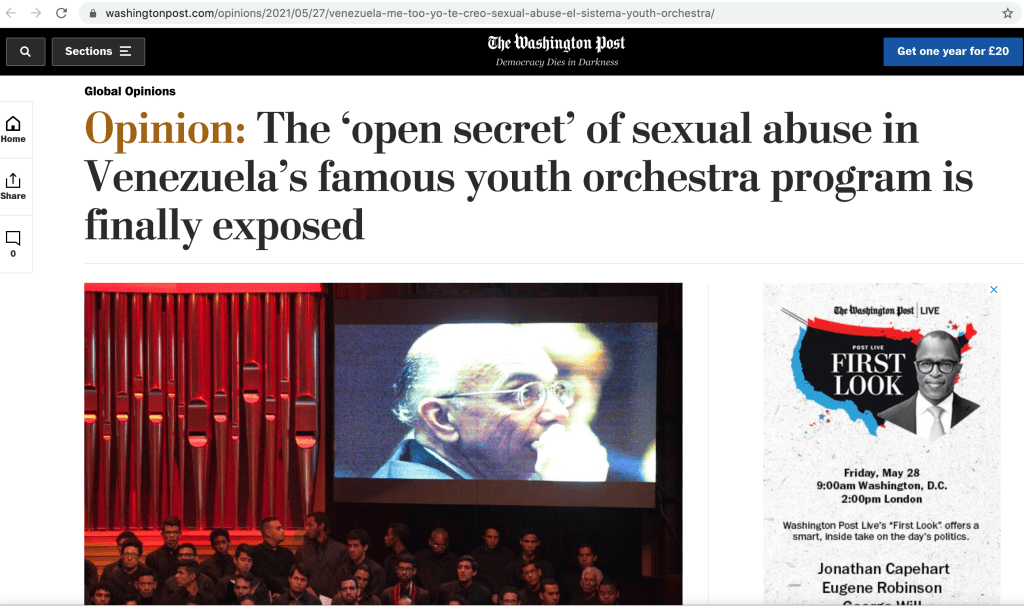
Another year, another Washington Post article about a sex scandal at a world-famous classical music education institution. This time, Juilliard; last year it was El Sistema. In both cases, the problem had been an “open secret” for decades before an investigation or public allegation triggered action.

But there is one big difference between the stories: the response of the music sector.

In the case of Juilliard, 450 composers, musicians, educators, and arts leaders, led by the composer Sarah Kirkland Snider, immediately signed an open letter demanding action. As the WP article concluded:

Snider and the as-yet-unnamed coalition of composers are planning their first in-person strategic meeting in January to discuss further actions in directly addressing “intersectional” abuse and harassment across the composition community and classical music in general — where systemic inequities and imbalances have roots that run centuries deep.

“The positive thing to say about all of this,” Snider says, “is that it’s one of the very first times — maybe the first time in the history of our composition community — that men and women and people of all genders have come together to stand up and protect one another. It’s such a momentous occasion in our field, and I think it speaks volumes about the possibility for growth and change.”

When the El Sistema scandal broke last year, however, the response was minimal. This despite the fact that the Venezuelan affair was, in many ways, worse: it involved the sexual abuse of minors within what was promoted as a program to rescue and protect young people from social problems. A small handful of the hundreds of El Sistema-inspired programs around the world made a public statement condemning the abuse – suggesting that such a response was appropriate – but the vast majority remained silent. None of the classical music celebrities who had endorsed El Sistema opened their mouths. Gustavo Dudamel, the program’s figurehead, kept quiet. There was no joint statement or collective action from the classical music or music education sectors.

There was a bit of a kerfuffle for a month or so, as the story circulated around the world, journalists confirmed it independently, and El Sistema made a statement, including a vague promise to investigate itself (something that, unsurprisingly, generated little confidence among Venezuelan musicians); and then the issue went away, because no one in the sector had committed to keeping it on the table. 18 months later, programs and musicians around the world continue to align themselves proudly with El Sistema, as though nothing had ever happened. The scandal is never mentioned. The consequences for the organization and for individuals have been negligible.

Why such a contrast between the two responses to the same problem?

I suspect that the silence around El Sistema had much to do with the extent with which this organization, unlike Juilliard, had infiltrated the classical music and music education sectors. It had been widely lionized by musicians, educators, and journalists. Many had promoted El Sistema and even adopted it as part of their identity. Speaking out would have implied an admission that they had made a mistake. That they had backed the wrong horse. That they had failed to do due diligence. That they had promoted an abusive organization. They would have had to renounce part of themselves. This kind of mea culpa was apparently too much for most.

The composers decided to protect one another by taking a public stand. But the international El Sistema sector, with only rare exceptions, opted for protecting the brand – in other words, saying nothing. It could have used its influence to push for change in Venezuela to improve safeguarding for current and future students, but it did not.

Whatever the reason, the contrast is stark. While the composers have spoken out and are organizing further action, the field of social action through music stayed silent and, for the most part, pretended that nothing had happened. Many people who proclaimed publicly their commitment to music and social justice failed to act when serious injustice raised its head. This, too, “speaks volumes about the possibility for growth and change” – but not in a good way.

One can only hope that a few in the El Sistema sphere are observing the Juilliard scandal and noting the difference between a robust response and sweeping the issue under the rug. It’s never too late to take a stand on a problem that is “embedded deep into the culture of classical music education,” as Snider says, and will continue until musicians and program leaders speak up en masse rather than look the other way. And as Snider et al.’s letter illustrates, taking a stand does not just mean making general statements decrying sexual harassment and abuse – it also means naming specific institutions, demanding concrete action from them, and holding them publicly accountable. El Sistema will not change substantially as long as it is given a free pass by the rest of the world.

“The Power of Music”: advocacy in disguise

When I saw that Susan Hallam and Evangelos Himonides’ monumental new book “The Power of Music: An Exploration of the Evidence” had been published, I went straight to my area of specialism – El Sistema – to see how they handled it. It turned out to be quite a prominent theme in the book; a search showed the word “Sistema” appearing 95 times. But I quickly discovered numerous problems with its treatment.

The authors seem to have gone out of their way to present a positive image of El Sistema. They omit any reference to most of the critical literature on this subject. Only a single article is presented as raising questions about El Sistema. Neither of the two academic monographs on this topic are included. Studies with mixed conclusions are cited, but only their positive findings are mentioned. For example, two of Gabriela Wald’s articles appear, but her arguments about social division and reproduction are ignored, along with her evidence that students dissented from dominant narratives of social action through music. The authors give no inkling that Wald is a critic of Sistema-style programs in Argentina. Provenzano et al. (2020) is present, but only its positive results are cited; there is no mention of the fact that “program participants reported experiencing a decrease in satisfaction with life from preintervention to postintervention” or that the researchers identified this finding as “a major limitation of this study” (three other significant limitations are also listed). Furthermore, the same authors’ earlier article (Hopkins, Provenzano, and Spencer 2017), which is considerably more critical of El Sistema, is not included.

The most substantial quantitative study (Alemán et al. 2017) is repeatedly cited without any reference to the obvious question marks over its methods, to published, critical discussions of its findings (Baker, Bull, and Taylor 2018; Clift, Phillips, and Pritchard 2021), or to its damning conclusion that El Sistema did not reach more than a small number of poor children. The study’s authors acknowledged that El Sistema illustrated “the challenges of targeting interventions towards vulnerable groups of children in the context of a voluntary social program.” As Stephen Clift (2019) has noted in reference to this study: “As poorer children were under-represented, far from addressing social inequalities, the work of the [El Sistema] centres served to reinforce them – entirely contrary to the idea of an intervention designed to reduce social and health inequalities.” But Hallam and Himonides are silent on this major finding that undermines all the other claims about the Venezuelan program. Worse still, they assert that El Sistema fosters prosocial behaviour when Alemán et al. stated clearly that they “did not find any full-sample effects on cognitive skills… or on prosocial skills and connections.”

And the list goes on. The authors use older literature reviews by Creech et al. (2013; 2016) rather than more recent ones by Puromies & Jovonen (2020) and Bolden (2021) in which more critical literature is surveyed or more ambivalent conclusions are drawn. They include an article built on media reports, documentaries, advocacy literature, and institutional publicity materials – in other words, one that has no place in this kind of book – and another based on fieldwork by a student with no research training. The book’s position on the Sistema-inspired field rests heavily on program evaluations, without any discussion of their limitations as evidence or their potential skewing towards positive conclusions. This is a topic about which there has been plenty of academic debate: Jancovich and Stevenson (2021), for example, raise questions about the credibility of evaluations, arguing that many “reinforce overstated celebratory narratives,” and Baker, Bull, and Taylor (2018) illustrate this point specifically in relation to evaluations of El Sistema. The first factual sentence on El Sistema (p.326) contains two errors: the name of its founder is wrong, and the authors incorrectly claim that El Sistema was created as social action through music (a term that was actually adopted decades later, as I have noted in several academic publications).

In short, the book shows not just errors but also an overwhelming bias in its treatment of El Sistema. Bias is not a problem per se – some would argue that there is no such thing as unbiased research – but it is a problem when it is not acknowledged. It is a real problem in a book that presents itself as an objective review of the evidence, rather than a work with an explicit stance.

Positionality statements, acknowledging and explaining potential biases, have become commonplace in the social sciences, and are little short of a requirement in PhD theses these days, yet there is no sign of one here. On the contrary, the book makes implicit claims to neutrality. It states: “An inclusive research strategy was adopted in accessing the literature to be included in this book,” and its subtitle is “an exploration of the evidence” – yet some of the most substantial evidence has been excluded. Its preface ends: “It is hoped that […] the reader will be enabled to make an informed decision about the power of music in a range of areas across the lifespan.” How can the reader make an informed decision when the authors withhold some key sources of information and misrepresent others? The authors have a partial view, and they give the unsuspecting reader no choice but to adopt it. This sleight of hand – advocacy disguised as objectivity – is distinctly troubling in what will undoubtedly become a cornerstone text.

To be clear, we are not just talking about a little bit of gentle favouritism here. Ten years of heated debate in books, articles, special issues, book chapters, conferences, newspapers, magazines, radio, TV, and social media are reduced to: “Not all of the research on Sistema-inspired projects has been positive.” Bibliographic leads for any reader intrigued to know more are almost entirely lacking. The authors’ claim about prosocial skills is squarely the opposite of the conclusion of the report that they cite – the academic equivalent of claiming that black is white. All academics make mistakes, but taken in the context of the treatment of El Sistema in the book as a whole, this is something else: Hallam and Himonides’ judgment appears to have been completely clouded by their advocacy stance.

I am reminded of Clift and colleagues’ recent critiques of large-scale surveys on the role of the arts in improving health and wellbeing, for losing sight of the crucial issue of the quality of the evidence in their focus on quantity. (In addition to the articles cited above, see here.) As we see above, there are several areas in which quality can be compromised in such surveys: in the studies that are cited (they may not be robust); in the way that they are cited (lack of critical scrutiny, selective reading, misrepresentation); and in the studies that are not cited (the omission of relevant but complicating evidence).

Another area is highlighted in a further article by Clift’s team: “vested interests” of academics performing the review. They ask: “Is the starting point of a review team one of ‘dispassionate enquiry and scepticism’ or is there a pre-established conviction […]? If the former, a review team may interrogate research methods and findings closely in the interests of establishing the truth or otherwise of claims made. If the latter, a review may be undertaken with the purpose of showcasing positive evidence.” This point is highly relevant in our case. Hallam and Himonides seem determined to sing the praises of El Sistema despite the many criticisms it has faced from other researchers, its obvious disjunctures with contemporary thinking on music, development, and social justice, and the string of public scandals (including repeated allegations of widespread sexual abuse) that undermine claims that it is a positive exemplar of “the power of music.” Why do the authors adopt this perplexing stance?

Rimmer (2020) provides important clues. It turns out that Hallam has advocated for the El Sistema model since 2010 and has been connected to the Sistema-inspired field in various capacities, including as a program evaluator and research supporter. Her husband was a driving force behind Sistema England and a member of its advisory board. Rimmer concludes that Hallam formed part of an “inner circle” and a “network of sympathetic voices” that served as key “sponsors” of Sistema in England. Hardly “dispassionate enquiry and scepticism,” then. Hallam’s vested interests in Sistema provide an obvious explanation for the bias in her review, including its ample, uncritical use of program evaluations. Rather than a neutral, inclusive exploration of the topic, as is claimed, the book is a prime example of what Owen Logan (2015) calls “Sistema-friendly research”: studies that “dovetail with the ‘spin’ coming from Sistema projects internationally, to the extent that researchers would appear to have a hand-in-glove relationship with the Sistema network.”

This slice of the book is highly anachronistic: rather than reflecting the lively academic debate on El Sistema that has emerged since 2014, it echoes the monochrome, ill-informed enthusiasm of a decade ago. It is a throwback to Hallam’s advocacy for Sistema England in the early 2010s – before independent research had begun to raise awkward questions, and long before a sexual abuse scandal in Venezuela led Sistema England to distance itself from the mother program (it closed down just months later). But ignoring the last eight years of vigorous and very public debate is no way for a literature review to proceed. Researchers of music education and social change should be perturbed that such a major work advocates for a program and a model that have been much questioned in recent years, and that it does so in such a problematic way. This book is a backwards step for El Sistema research and practice, and with its endorsement of the status quo, it may constrain much-needed reform and rethinking.

The fact that this problematic presentation of El Sistema comes from one of the most lauded figures in the music education field also raises uncomfortable questions about the reliability of academic discourse on the social impact of music. To be sure, I have examined just one sliver of the book, though with 95 mentions, it’s a significant one. But a question that emerges from Clift et al.’s work in this field is that if we take one element of a wide-ranging review and find it flawed, then how can we have confidence in the review as a whole or in its higher-level conclusions? If quality is compromised at a granular level, then the whole edifice is shaky, however impressive it may seem at first glance.

How many other hidden agendas are woven into the text, how much more of the evidence consists of sub-standard studies, and what else has been partially reported or omitted for not fitting with the story that Hallam and Himonides wish to tell? Answering that question in a comprehensive manner would be an unfeasibly large task, and maybe an impossible one, since a thorough knowledge of the literature on any given topic is required in order to spot potential bias. But the section on “Music and victims of abuse” deals only with music as a form of treatment or therapy; there is no mention of the well-known problem of sexual harassment and abuse within music education institutions. El Sistema makes an appearance in this section too, but (of course) only in a positive light; nothing is said about the abundant evidence of abuse of various kinds within the Venezuelan program, which has been reported in several academic publications and numerous international media outlets. The chapter on “Psychological wellbeing” has little to say about musicians’ wellbeing and the risks and emotional harms of musicianship for some, as eloquently discussed by Musgrave (2022). The section on “Social inclusion” makes no reference to critiques of this concept and its attachment to culture and education. In other words, there are signs that El Sistema is not a unique case in this book, and that critical questions and complicating evidence concerning negative aspects of music and music education may have been downplayed or elided in a more consistent fashion. If that is the case, then readers will have to look elsewhere in order “to make an informed decision about the power of music.”

Children of Las Brisas: a review-essay

“The huge spiritual world that music produces in itself ends up overcoming material poverty.” These words, or variations on them, by El Sistema’s founder, José Antonio Abreu, are repeated reverently in countless media portrayals of the world-famous Venezuelan music program, including a series of propagandistic documentaries that began with Tocar y Luchar (2006). At last, though, there is a film that puts them to the test: the remarkable Children of Las Brisas (2022), which, in its subtle exploration of the complexity and ambiguity of El Sistema in particular and the power of music more broadly, puts all its predecessors in the shade. This is not an El Sistema film, said its producer at the premiere in London; yet it gives far more insight into the program than the films that tackle the subject head on.

Despite the producer’s disclaimer, the first half of the film follows the established El Sistema documentary template fairly closely. Three talented young musicians are rising steadily up through the ranks of the program. They declare their love for music in moving terms. We meet their families, learn about their domestic dramas, see daily life in their low-income neighbourhood of Las Brisas, and peer inside the El Sistema music school in Valencia that has become a central point in their lives. We share their triumphs: Dissandra makes it into the National Children’s Orchestra and travels to Salzburg to play under Simon Rattle; Wuilly joins the Caracas Youth Orchestra, another prestigious ensemble. Abreu makes his usual oratorical appearance, sermonizing about the power of music, and the students’ experiences seem to bear out his vision. The film is too well made to fall into cliché, but its first part will feel familiar to anyone acquainted with media portrayals of El Sistema.

But then everything changes. The heroes’ journey is rudely interrupted: all three fail a crucial audition in Caracas. They are suddenly out in the cold; the dream of an El Sistema salary has vanished. Wuilly is forced to busk in the capital in order to survive; for a while he even has to live on the street. Dissandra plays background music in a restaurant, but this is not enough to make ends meet. She emigrates to Peru, where she too (barely) survives by busking. Edixon, under intense financial pressure like the others, decides to join the army – clearly a painful choice, given his dislike of the Venezuelan government. Having started down a familiar path, the film makers kept going when the story took a darker turn. They did not set out to critique El Sistema, but reality did that for them.

Children of Las Brisas is a moving story of individual and collective struggle, of connection and separation, and it will speak on an emotional level to a wide audience. Most obviously, it is a close-up portrait of the Venezuelan crisis. Yet it is a dense, rich film that operates on multiple planes and also opens up a number of intriguing questions for those with more specialized interests. It is about failure and decline – of a country, and of its most famous cultural symbol. We witness Venezuela, and El Sistema, falling apart. The film interrogates idealistic narratives of music education through the lens of one of its most famous examples. This is not a romanticized story of triumph against adversity, nor of the power of music to change the world. El Sistema does not arrest the country’s decline; indeed, through its incorporation as a propaganda tool it becomes part of the problem. It is unable to provide a lifeline even for the three protagonists, let alone for the country as a whole.

If the film starts with Abreu’s idealistic words about music’s spiritual richness overcoming material poverty, it ends with a dose of cold reality: its protagonists – all of three of whom are talented and have dutifully followed Abreu’s prescription of “work and study” – are struggling to survive economically. Dissandra even wonders out loud whether all those years of single-minded dedication to classical music, of “playing and fighting,” were really worth it. (Tocar y luchar – to play and to fight – is El Sistema’s slogan.) This is unheard of in El Sistema documentaries: doubts over the validity of the program’s mantras. With the protagonists’ classical music dreams in tatters, the film closes with Abreu’s idealistic rhetoric looking equally threadbare.

A crucial element of this story is one that is usually downplayed or ignored in media and advocacy accounts: money. The three students had to break into (or remain in) one of El Sistema’s three “professional” youth orchestras in order to keep going. Failure meant being forced to do something else for a living. The extraordinary thing about El Sistema in its heyday was that it offered a decent salary to a small percentage of its students (the most talented, not the most needy, as access to the salary was via audition), and this salary (or the aspiration to attain it) played an important part in keeping the students motivated and the institutional wheels in motion. In the early days of El Sistema, Abreu lured music students away from other projects and music schools by offering them scholarships. In private, students would joke that El Sistema’s slogan should really be tocar y cobrar­ – to play and get paid. In other words, the real story of El Sistema was less about the salvational power of art, and more about the program’s unprecedented resources and how they were distributed – a story as much about the power of money as about the power of music.

This angle to the film comes out in fleeting but crucial scenes. To be sure, the students speak lovingly about music itself. But at one point, Edixon shows his mother his viola: “This thing has value. It’s going to bring in real money.” Dissandra’s mother tells her: “Music is your passport to success.” Forget spiritual richness: for these young people and their families, music was an economic or career strategy. Forget changing the world: this was about the promise of social mobility for a few talented individuals. But El Sistema held all the cards. Through his brilliant if dubious financial management, Abreu had created a classical music bubble economy in Venezuela, built on oil revenue (where else in the world were teenage orchestral musicians paid adult salaries?). But his steady monopolization of the Venezuelan music scene had left most of the power with El Sistema and little with its students, breeding a culture of dependency. In the film, all it takes is one failed audition for things to fall apart. Music or the viola couldn’t provide for these students in Venezuela; only El Sistema’s patronage could. Many films have portrayed the inside of the bubble, without recognizing its real nature; Children of Las Brisas shows us life on the outside and then, in quick succession, what happened when the bubble burst.

The words of Dissandra’s mother – “music is your passport to success” – come back to haunt the film, not just because success turns out to be elusive, but also because her daughter’s chances eventually hinge on a passport – a real identity document, not an imagined artistic one. It turns out that for Dissandra, music, without the legal ID, is a passport to nothing. In this film, the ideal is repeatedly overwhelmed by the real.

Much of the film’s interest comes from its implicit questioning of the kinds of heart-warming slogans and aphorisms that underpin El Sistema and the international field it has spawned. One of its most powerful moments issues just such a challenge, though in a way so subtle that it will probably be missed by viewers not well versed in this field. After his musical dreams are nixed by El Sistema’s uncompromising filtering for talent, and with economic necessity pressing down on his family, Edixon joins the army. Or, as the film tells us, he exchanges his viola for a rifle. This is striking enough on its own, but the resonance is all the greater for those who spot its inversion of another El Sistema motto that is famous not just in Venezuela but across Latin America: a child who takes up a musical instrument will never take up a weapon. Perhaps the film’s makers should have made this point explicitly for the uninitiated; but once again, they show that reality is much more complex than Abreu’s famous mottos.

Poignantly, Edixon reasserts his enduring love for his viola near the end of the film, long after he has been cast aside by El Sistema, and as he struggles to make a living outside of music. I recalled something that an El Sistema student told me back in 2010. The program cares little about individuals, he said; they are easily replaceable: “You may love El Sistema, but it doesn’t love you.” On one level, Children of Las Brisas is a story of unrequited love for El Sistema and for music.

At a more everyday level, the film captures well the detail and atmosphere of El Sistema. There is plenty of the camaraderie among students, the space of sociability that the music school provides, the formation of a new “family” there. But there are also glimpses of the authoritarian, male-dominated organization (there are lots of maestros); of the arbitrary, disempowering, intimidating institutional culture (when crucial auditions in Caracas will happen is anyone’s guess, and Wuilly is called to one – in front of twenty teachers – at a single day’s notice); and the survival-of-the-fittest ethos that lies behind the discursive smokescreen of “social inclusion” (students constantly competing against each other in auditions, and little interest paid to the “failures”).

Dissandra and Wuilly both make it into the top echelons of the program, only to be cast out again. And once their star starts to fade, so does their adopted “family.” Despite all the talk about the collective, in El Sistema the students rise on their own and fall on their own. When the going is good, they move to Caracas from their home town, leaving their real and adopted families behind. The highly centralized El Sistema is a case study of music disrupting existing social bonds as it creates new ones. The scenes of camaraderie involving Wuilly will have an edge to them for any viewer familiar with his public falling-out with El Sistema and his fellow musicians shortly afterwards (I also remember well how his former colleagues attacked him mercilessly on social media). In the end, all three protagonists had to go it alone.

The film is not beyond criticism. It is a little too reverent in its treatment of Abreu, following the erroneous tendency to pin the blame for El Sistema’s decline squarely on its appropriation by Chávez, and overlooking Abreu’s complicity. It was Abreu who crafted El Sistema’s “musical populism” to appeal to the ears of Venezuela’s populist presidents. It was Abreu who made overtures to Chávez, not the other way round. In 2014, El Nacional journalist Diego Arroyo Gil described El Sistema’s founder as a serial flatterer of political leaders who often appeared at their side, “smiling, like Caesar’s special guest.” Abreu was no one’s victim. Political collaboration was his modus operandi, and El Sistema’s reduction to an outright tool of political propaganda was a consequence of his Faustian pact.

In its eagerness to criticize the Venezuelan government, the film underplays not only Abreu’s flaws but also those of his program. After all, it was El Sistema’s Darwinism that provided the turning point in the protagonists’ musical lives. The program’s problematic features (such as authoritarianism, arbitrariness, opacity, gender bias, and sexual harassment) are legion and increasingly well documented. What’s more, they have been in El Sistema’s DNA since the start, to judge from interviews that I carried out with older musicians in Venezuela; some were noted by external evaluators in the late 1990s, before Chávez came to power; so they cannot be laid at the door of the Bolivarian Revolution. The notion of El Sistema as an exemplary program until Chávez came along and ruined it is a popular one in Venezuela, but it is a fantasy, built on a relentless PR operation and the silencing of critical voices.

(Interestingly, the film’s website is rather more directly critical of El Sistema than the film itself: “the impoverished families were sold a social narrative with no conclusion. Education was prioritised over subsequent employment or even basic needs, flooding a society with thousands of violinists at a time when it was struggling to feed its children.” Perhaps such critiques ended up on the cutting-room floor.)

Nevertheless, these are minor quibbles about an otherwise exceptional documentary. Much more important are the larger questions that it poses. It is reminiscent of the classic documentary Hoop Dreams – another film that is about much more than its ostensible subject (in this case, basketball). It focuses on the shadow of failure hovering even over the talented in highly competitive worlds like sport and classical music. These kinds of stories are very rarely told; most writers and film-makers just pluck out a few exceptional cases and create musical inspiration porn. Yet these stories may reflect the experiences of the majority. Hundreds of thousands of Venezuelan children have grown up dreaming of being Dudamel, but how many Dudamels are there today? And how many Dissandras, Edixons, and Wuillys, busking on foreign street corners or forced to abandon their musical ambitions altogether? If Hoop Dreams exposed the faultlines and the elusiveness of the American Dream, Children of Las Brisas does the same – beautifully, if painfully – for El Sistema’s Venezuelan Dream.

For screenings in London on Monday 22nd and Wednesday 24th August, visit: https://dochouse.org/cinema/screenings/children-las-brisas-qa

National Youth Music Organisations on the move: what does this mean for SATM?

Inclusion. Community. Youth voice. Sharing and empathy. Excellence of experience, not just of musical sound.

These are commonplace ideas in the field of social action through music (SATM) and they were central themes of a public seminar on 17 March. But this was not a SATM event: it was a debate organized by the UK’s Music Education Council (MEC), entitled “The Importance of National Youth Music Organisations and Centres of Advanced Training.” It featured representatives of some of the UK’s most hallowed youth music ensembles, including the National Youth Orchestra, the National Children’s Orchestra, and the National Youth Choirs. If music education has traditionally been constructed as a pyramid, this was the apex on show.

It was fascinating to see how the language and aims of the elite end of the music education sector have shifted towards those of socially-oriented programs in recent years. The centre of gravity of the youth ensemble world is moving towards SATM’s stated goals. This might justifiably be seen as a vote of confidence in SATM. But it also poses a subtle challenge for a sector that historically defined itself against the norm.

If ideas such as inclusion, community, and youth voice become mainstream in the large-ensemble world, even among high-performance groups, then what will be distinctive about SATM? What will be its USP (unique selling point)?

The logical conclusion is that SATM will need to up its game if it’s going to offer something distinctive. It will need to embrace pedagogical innovation and strive harder to centre and achieve its social goals. It will need to move forwards if it is not to look like it is moving backwards relative to the mainstream youth music sector. The MEC seminar could be seen as a pat on the back for SATM, but also as a spur to action.

In fact, the issue is not just that the mainstream may be catching up with SATM; it may actually be overtaking it in some places. The MEC seminar revealed the UK’s traditional elite to be more progressive than some of the most celebrated SATM programs in certain ways (for example, in the routine involvement of young people in governance). This is a warning against complacency and outdated alignments, which have held back some parts of the SATM field.

An important takeaway from the MEC event was that if programs are to be socially progressive, they also have to be musically progressive. Fully embracing youth voice means giving young people full control over the music – empowering them to make the music that they want to make, the music that is relevant to their lives. The social goal (youth agency) needs to be embedded in the musical process. A program that is distinctive is likely to sound distinctive.

This presents a particular challenge for SATM, given that the field’s most famous exemplars have been musically conservative. How to break away from the reproductive model of the past and embrace musical creativity in all its guises? How to put young people – not the conductor, the composer, or the musical work – at the centre of the musical process? SATM’s best-known programs do not provide much of a lead. It was noticeable at the MEC event that the programs that are most youth-driven at a musical level are the least conventional ones (such as Urban Development and the National Youth Folk Ensemble), which are not focused on large ensembles or classical music. This poses questions for SATM, which has historically centred these tools and been rooted in the classical orchestral world. What justification is there for continuing down this path when there is so much evidence of the advantages of other ones?

Even the traditional elite are now calling classical music “the elephant in the room.” They are pointing to genre fluidity as the future. They are dismissing instructionism (a pedagogy of adults instructing children in technical skills, which is the bedrock of SATM’s first-generation programs) as an old-fashioned approach. The National Youth Orchestra says that it is no longer an orchestral training program, while the National Children’s Orchestra is reconsidering the meaning of excellence. This is a sector on the move, its rethinking of its practices and purpose turbocharged by the Covid pandemic. SATM cannot afford to sit on its laurels.

The MEC seminar showed the apex of the UK’s music education pyramid looking critically at itself in public. Representatives acknowledged that dance education has been more progressive than music, despite having less funding; that music organizations should learn from their youth work equivalents, which have been doing deeper work for longer; that a potential gulf exists between musical skill and capacity to work with young people. Such public realism is salutary (and it has not historically been the norm in SATM).

If even the National Youth Music Organisations and Centres of Advanced Training are raising such critical questions, the writing is clearly on the wall for some of the foundational tenets of SATM. The good news is that new ones are already being written in certain places; some programs are forging less conventional paths, as described in my most recent book. But the field could go further: there is still plenty of attachment to old and increasingly questioned ideas. The MEC seminar saw leading youth music organizations come together and not only commit to new ways of thinking but also distance themselves from old ones and acknowledge their historical shortcomings. This is something that SATM as a sector is still reluctant to do, but with National Youth Music Organizations on the move, the pressure is on.

The Dream Unstarted: El Sistema’s discordant notes

The Inter-American Development Bank identified El Sistema’s excessive centralization in Caracas as a key weakness when it became involved with the Venezuelan youth orchestra scheme in the late 1990s. In 2007, the bank made a loan to finance the construction of high-spec music centres in seven regional cities in order to decentralize the program. The new centres were the major element (more than 50%) of a $211 million package for El Sistema: $150 million provided by the IDB and $61 million by the Venezuelan state. One, in the city of Barquisimeto, was designed by Frank Gehry and was to be named Dudamel Hall, a reflection of the famous conductor’s warm relations with Venezuela’s political leadership.

The buildings were due to be completed by 2011. However, in my 2014 book on El Sistema, I drew attention to the fact that these centres had not been built, or even started, by that year. In a 2016 blog post, I noted that while the regional centres remained unrealized, El Sistema was pouring resources into a huge new building in Caracas, which was not in the original IDB plans – indeed, which flatly contradicted the bank’s stated goal of decentralization. As well as questioning the logic behind this move, I wrote that “there’s a real risk of this building becoming a white elephant.” Yet despite the global profile of El Sistema and the large sums of public money involved, no one else engaged with the story. I devoted a 2017 blog post to this topic under the heading, “Is anyone paying attention to the big issues?”, and asked:

Is there any mention or explanation or discussion of this 180-degree turn anywhere? […] El Sistema is a major classical music story that tens of thousands of people around the world follow avidly, yet no one seems to notice or care about the big issues. Far more attention is paid to trivial details like paper violins than to an illogical volte-face with a price tag of over $100 million.

Today, a team of Venezuelan investigative journalists published a detailed report on the phantom centres. They confirmed that, fifteen years after the contract was signed, not a single brick of the original seven centres has been laid. The half-built Caracas centre has been on hold since 2020 due to a lack of resources. The report highlights the illogicality of reducing a national program of decentralization to the construction of a single building in the capital. In the regional cities identified by the IDB, instead of the modern music complexes that had been planned, the reporters found borrowed or rented facilities in a poor state of repair, with some having closed altogether. A number of music schools in Venezuela’s second city, Maracaibo, were listed as operational on El Sistema’s website but were found to be shut or even non-existent – the kind of discrepancy between publicity and reality that I have been highlighting for a decade. Similarly, El Sistema’s CEO, Eduardo Méndez, claimed that demand was surging and he outlined plans for expansion; however, music school staff interviewed by the reporters spoke of declining numbers of teachers and students.

This decline is hardly surprising, given that many staff receive only “symbolic salaries.”  Of the huge sums allocated at the top of the program, only a few drops reach the bottom. The reporters interviewed a former El Sistema teacher who left after receiving no payment for a year, calling the program “a swindle,” and a current teacher who described what is almost a kind of indentured labour. He is paid a miserable $6 a month, yet he said:

I can’t leave. If I quit, they’ll take away my instrument.

Without an instrument, he would be unable to moonlight at the weekend, playing the gigs that allow him to maintain himself.

How much money has been paid out by whom and what it has been spent on remains something of a mystery; the report details wildly contradictory figures in official financial accounts, and the IDB and the Venezuelan government refused to clarify the situation to the journalists. This is the sobering, messy, murky reality of El Sistema – one that has long been obvious to serious observers but ignored by so many, at home and abroad, who only want to see a “Venezuelan musical miracle.”

That it has taken so many years for this story to be investigated and aired in the media simply illustrates the iron grip that El Sistema has maintained on the public narrative throughout its history. The program’s founder and long-time director, José Antonio Abreu, infamously used bribes and threats to keep the Venezuelan media on a tight leash and El Sistema’s scandals out of the news. To my knowledge, the last critical investigative report on El Sistema dates from 1994: Rafael Rivera’s “The Philanthropic Ogre.” (Today’s investigation is not the first to focus on financial murkiness: Abreu’s slush fund and “strange, improvised” movement of money was a focus of a 1990 article by Roger Santodomingo.) Now, nearly 30 years later, Venezuelan investigative journalists have once again pierced the heavy veil of silence that covers El Sistema and keeps its realities away from the ears of the world.

In 2014, I wrote that El Sistema had numerous skeletons in its closet and that more evidence would eventually come to light. This year it is failures of planning and infrastructure; last year it was sexual abuse. 2018 saw unpublished and unflattering evaluations of El Sistema emerge, including highly critical reflections by current and former members of the program; while in 2017 Abreu’s phantom PhD was rumbled and the IDB published evidence of a low percentage of poor beneficiaries and minimal social impact (undermining El Sistema’s two major claims to fame). The year before that, former El Sistema violinist Luigi Mazzocchi painted a detailed portrait of institutional malpractice to Larry Scripp for an article in VAN Magazine. That’s quite a few skeletons for what was once hailed as one of classical music’s biggest success stories, and yet the closet is far from empty.

UPDATE: 16 March

On the eve of the publication of this investigation, the IDB clarified to the reporters that responsibility for the failure to build the music centres lay squarely with El Sistema. The investigative team also noted that the decision to focus resources on a second HQ in Caracas, rather than the regional centres specified in the grant agreement, was described by Eduardo Méndez as “a strategic decision by Maestro Abreu.”

As explained in my 2017 blog post, the IDB identified decentralization via the construction of regional centres as a priority in 1997. Indeed, it argued that constructing a headquarters in Caracas “would be appropriate only if it were accompanied by the Regional Centres.” El Sistema failed to act on this directive in Phase I of the IDB project, building only the first Caracas HQ. So when the IDB issued its second and much larger Phase II loan in 2007, it reiterated that the central goal was “to deconcentrate El Sistema” via the creation of “an intermediate regional level.” But history simply repeated itself: again, the regional centres were forgotten; again, El Sistema only built a complex in Caracas (this time unfinished).

From the point of view of infrastructural development, the last 25 years of El Sistema – and the IDB’s relationship with the program – have been a resounding failure. The desolate picture in regional cities today contrasts starkly with the elaborate plans that were made (and financed) all those years ago. And as Méndez revealed, the buck stops with José Antonio Abreu, who was responsible for the abandonment of El Sistema’s top strategic priority over the last quarter of a century.

¡Ya disponible! “Replanteando la acción social por la música”

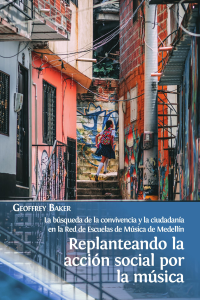
Existe una narrativa de acción social por la música (ASPM) que resulta familiar en el Norte global: el programa orquestal venezolano El Sistema, creado en 1975, irrumpió en la escena musical clásica internacional en 2007 con el debut de la Orquesta Juvenil Simón Bolívar en los Proms, dando lugar a un movimiento global inspirado en El Sistema. Pero hay otra vertiente en esta historia, en la que se fundaron programas influenciados por El Sistema en América Latina en la década de 1990. Uno de estos programas fue la Red de Escuelas de Música de Medellín, que se inauguró en 1997 y trabajó de la mano de El Sistema durante sus primeros siete años. Este programa de orquestas y bandas pretendía promover la convivencia en la segunda ciudad de Colombia, que se había ganado la infamia de ser la capital mundial del asesinato durante el apogeo del Cártel de Medellín de Pablo Escobar, y formaba parte de una estrategia más amplia de renovación urbana que se conoció como “el Milagro de Medellín”. Este es el tema central de mi nuevo libro, Replanteando la acción social por la música: La búsqueda de la convivencia y de la ciudadanía en la Red de Escuelas de Música de Medellín (Open Book Publishers, 2022).

Mi libro anterior, El Sistema: Orchestrating Venezuela’s Youth (Oxford University Press, 2014), exploraba las complejas y a veces desagradables realidades detrás de la espectacular fachada del programa más famoso de la ASPM. En él argumentaba que era hora de reevaluar El Sistema y reconsiderar la admiración generalizada hacia este modelo. Desde entonces, me ha interesado cada vez más la pregunta que planteé al final de ese libro: ¿podría la ASPM funcionar mejor fuera de Venezuela? ¿Qué podría aprenderse, me preguntaba, estudiando otro programa de este tipo y comparándolo con el original? En 2017-18, pasé un año realizando trabajo de campo en Medellín, buscando respuestas.

Resultó que en 2007, el año en que la “Sistemanía” se impuso en Europa y Norteamérica, el programa ASPM de Medellín ya había tenido problemas y había empezado a replantearse el enfoque de El Sistema. En 2005 había asumido el cargo una nueva directora, que al año siguiente había elaborado un detallado informe crítico sobre la Red, proponiendo un cambio de rumbo. A medida que la ola de entusiasmo por El Sistema se extendía por todo el Norte, la Red se distanció del modelo venezolano, embarcándose en un proceso de reforma que ha continuado desde entonces.

Otro estudio interno detectó un grave problema en la Red: un alto porcentaje de alumnos de música avanzada mostraba arrogancia, exclusión hacia sus compañeros y falta de respeto hacia sus profesores. Sucesivos informes contrastaban la teoría (de que la música genera valores sociales positivos) y la realidad encontrada dentro del programa (de divisiones, rivalidades y actitudes negativas). Esto fue una bomba, teniendo en cuenta que la Red fue financiada por la ciudad para promover la convivencia.

Con estos informes internos, las perspectivas críticas se integraron en el más alto nivel del programa. Los altos cargos llegaron a la conclusión de que el enfoque original de la ASPM estaba demasiado centrado en los resultados musicales y que la Red, como programa social financiado con fondos públicos, debía tomarse más en serio el aspecto social. Cuestionando la falta de voz y agenciamiento, intentaron empoderar a los estudiantes y adoptar un ethos más participativo, para distanciar el programa de las dinámicas de lástima y caridad, y potenciar la variedad musical y pedagógica. La Red se embarcó en una búsqueda de mejora, que partió del reconocimiento de que el modelo ortodoxo de la ASPM no conducía a los resultados deseados en cuanto a convivencia y ciudadanía.

Durante mi año en Medellín, observé una nueva ola de reformas, que se centró en la identidad y la diversidad (más énfasis en la música colombiana); la creatividad (un mayor papel para la improvisación y la composición); la reflexión y la participación (un cambio hacia un aprendizaje basado en proyectos); y el territorio (conectar la Red con otros actores culturales de la comunidad, y escuchar más a la ciudad).

Este proceso no estuvo exento de dificultades. El replanteamiento y la reforma generaron debates internos y la resistencia de algunos miembros del personal y de los estudiantes. La relación entre los aspectos musicales y sociales del programa y entre la música clásica y la popular surgieron como fuentes particulares de tensión. Observé cómo los líderes intentaban injertar filosofías y prácticas educativas progresistas en un programa de música relativamente convencional.

El estudio de este proceso de quince años de divergencia y cambio nos dice mucho sobre las limitaciones del modelo ortodoxo y el potencial de la ASPM para trascenderlo. También arroja nueva luz sobre la investigación académica, ya que los análisis internos de la Red muestran muchos paralelismos con los estudios críticos sobre El Sistema y programas similares que se han publicado internacionalmente desde 2014. La experiencia de la Red puede tener una relevancia considerable para muchos otros contextos de todo el mundo en los que se ha adoptado y adaptado El Sistema.

El surgimiento de la autocrítica y del cambio del modelo dominante de ASPM desde dentro del campo es un acontecimiento significativo. Hasta ahora, la investigación crítica sobre el ASPM se ha situado a menudo como divorciada de la práctica y externa al campo y, por lo tanto, desechada o ignorada. Ahora, la fuente de la crítica es un importante programa de ASPM.

Más allá de este estudio de caso sobre el cambio, también propongo un replanteamiento más amplio de la ASPM, mirando al futuro del campo. Se han producido cambios significativos en la sociedad y en la educación musical desde la fundación de El Sistema, lo que sugiere que el modelo central de la ASPM merece, como mínimo, una revisión. Reflexionando sobre la búsqueda de alternativas y mejoras en varias partes del mundo, propongo cinco áreas como prioridades para una mayor atención: lo “social” en el ASPM y su relación con las prácticas musicales; la decolonialidad y el enfoque de la ASPM sobre la música clásica; las dimensiones políticas de la educación musical con orientación social; la ciudadanía artística; y la demografía y la selección de los beneficiarios.

Existen retos y obstáculos para la reforma. Entre ellos, la circulación del conocimiento y el debate público limitados; la lenta evolución de la formación del profesorado; la resistencia al cambio desde dentro de la ASPM; y la influencia conservadora de El Sistema y de algunos de los principales financiadores. También planteo tres dilemas de tipo más conceptual. ¿Constituye la ASPM un medio eficaz y eficiente para abordar los principales problemas sociales? ¿Está el ASPM ineludiblemente enraizado en la ideología colonialista? ¿Y es el ASPM intrínsecamente peligroso debido a su susceptibilidad de apropiación por parte de intereses políticos o comerciales? Estas preguntas cuestionan la validez de la ASPM como concepto.

Concluyo considerando las posibilidades de transformación, invitando al lector a imaginar una ASPM para el futuro, una que sea socialmente impulsada, emancipadora, realista, sostenible y más profundamente latinoamericana.

Me senté a escribir este libro sobre el cambio en la ASPM a finales de 2019. Apenas unos meses después, COVID-19 y el resurgimiento de Black Lives Matter hicieron que algunas de mis preocupaciones centrales (como los grandes ensambles y el eurocentrismo) ocuparan un lugar mucho más importante en la agenda pública, y surgieron grandes preguntas en todo el mundo sobre cómo podría o debería ser la educación musical en el futuro. En 2021, voces progresistas de muchos ámbitos de la vida humana se preguntan si debemos volver precipitadamente a una vieja normalidad que ya estaba rota. Si alguna vez hubiera un momento para replantear la acción social por la música, sería ahora.

“Engineering” social action through music

In a recent study carried out in Colombia, Cespedes-Guevara and Dibben (2021) found that a year of training in a classical music instrumental program had no significant effect on prosociality or empathy. Their results echo those of other studies of similar programs, such as Alemán et al. (2017) on El Sistema in Venezuela, and Ilari et al. (2018) on an El Sistema-inspired program in the US.

Does this mean that music education doesn’t foster prosociality and empathy? No. There are other studies that suggest the opposite, such as Rabinowitch (2012) and Van der Vyver et al. (2019). But these studies involve musical activities and games that were expressly designed to promote prosociality or empathy. The null outcomes emerged from more conventional music education programs like El Sistema. The conclusion is clear: music making that is shaped with prosocial goals in mind is more likely to achieve those goals than conventional activities like playing in a youth orchestra. This is perhaps an unsurprising conclusion, yet it is one that poses a challenge to the social action through music (SATM) field, which is founded on El Sistema’s reading of conventional musical training through a social lens rather than designing of music education to maximize social impact.

Ilari et al. arrived at the same point. They note that “effects of music education on children’s social skills have been found mainly in programs that followed specialized curricula,” and

“for music education programs to be effective in developing social skills, perhaps it is necessary to devise curricula that not only break down traditional hierarchies found in collective musical experiences, but also afford children ample opportunities to exercise social skills such as empathy, theory of mind, and prosociality in more direct ways.”

In a more recent article on the potential of music to effect social change, Rabinowitch (2020) explores this idea further. She asks:

What if we could intentionally “engineer” new forms of music or music-making designed to maximise the positive effects of music on social skills? 

She suggests that “in order to optimise its social impact, engineered music-making should involve informal, even improvisational, highly mutualistic joint performance,” and that it would be advisable to emphasize collaboration rather than competition.

“It might be similarly important to focus on the process of creating music rather than on its end result. That is, the aim of the activity might not be to produce a well-polished concert, but to participate in the music-making”

These studies thus provide a clear steer away from SATM’s historical roots in concert performance of canonical orchestral repertoire, and towards more innovative design.

Urging the field to put social objectives at the heart of practice as well as discourse was one of the key messages of my most recent book, Rethinking Social Action Through Music. There are other ways that Cespedes-Guevara and Dibben’s study intersects with my own – perhaps unsurprisingly, given that both looked at SATM in Colombia. Theirs included a comparative element, involving also dance and sport programs. They observed a difference between the young musicians and footballers, which was signalled to them by the director of a music program:

Regarding violence prevention and community transformation, the children in the football programme are more concerned with transforming the dynamics of violence in their territory; those of the orchestra are more oriented to their own life project. We have tried to balance these things, because what we observe is that the orchestra children develop these skills very well and their life projects are very reflective and critical, but when it comes to thinking about their territory and influencing their territory to transform it, it’s not that strong.

(Director, industry-sponsored youth symphony orchestra)

Cespedes-Guevara and Dibben continue:

“Informants from the music-training projects described the individual transformation, whether actual or intended, as a journey away from the home  community, and by implication its associated criminality and poverty, saying, for example, ‘that music, somehow, helps them escape’ (Director, infant and  youth symphony orchestra), towards the world of music constructed as a particular orchestra and/or as the classical music world more generally: ‘…it was bringing the children closer to classical music… to bring these children from this community closer to the orchestra Philharmonic or classical music’ (Director, non-profit music school). Music and the community are constructed as two separate worlds, demarcated by music genres and associated lifestyles.”

The director of an orchestral program explained this last point:

“[W]hat this type of music does is to open themselves to a different world. So you see the young people who listen to reggaeton, who listen to other types of music, and these children from the foundation, I don’t claim that they don’t [listen to reggaeton], but they are more immersed in another style of music and in another lifestyle.”

Cespedes-Guevara and Dibben conclude:

If, as this implies, the two worlds are separate, transformations that take place for the individual stay with that individual rather than benefiting the community from which they come

Several themes may be drawn out here. First, for all the emphasis on collective music-making, SATM appears to be an individualizing process; and for all the talk of social change, SATM seems to promote escaping from social problems rather than facing them. Cespedes-Guevara and Dibben found that young footballers were more committed to transforming their community than young classical musicians. The prosociality and life-project findings might be seen as two sides of the same coin: if SATM fosters orientation to a personal life project, then it is hardly surprising that it does not promote prosociality.

There are close parallels with my argument in my book:

the figures at the top of the SATM pantheon—particularly conductors like Gustavo Dudamel—are those who have established themselves in orchestras overseas; they symbolize an ideology of music as a means of individual social mobility and transcending the local, rather than as a catalyst for collective social change within and for the community. Here we see a paradox in orthodox SATM: an idealization of the collective (the orchestra), yet an individualized conception of success (the young musician who “makes it” in the profession).

Among the mistranslations that occurred when SATM was adopted in the global North after 2007 was to describe it using the language of social change, when in reality the field’s “social turn” in Latin America in the 1990s was underpinned by the notion of social mobility.

A lack of territorial connection and commitment was recognized as a significant weakness by the leaders of the Red de Escuelas de Música de Medellín during my fieldwork, and they addressed it by converting the program’s social team into a territorial team.

Next, Cespedes-Guevara and Dibben’s argument about SATM fostering social separation, mediated by musical genre, finds a close echo in my book, with its emphasis on classical music and boundary-drawing:

the characteristic dynamic of the collective in SATM is not the much-touted teamwork—of which the conductor-led orchestra is in fact a strikingly poor example—but rather tribalism.

I too observed the dichotomy of classical music and reggaetón. As I noted, a member of the Red’s social team characterized the attitude of some of the program’s students to their peers as

you, so simpleminded, just listening to reggaetón and me, so sophisticated, listening to Beethoven

The fact that our two studies independently came up with similar findings from similar programs in different Colombian cities is undoubtedly suggestive.

Cespedes-Guevara and Dibben note two points of interest – or perhaps, two sources of tension – for critical researchers of socially-oriented music education: (1) with music widely assumed to do good, neither practitioners nor sponsors are necessarily interested in research on the social impact of such programs; (2) the more specific assumption that classical music is particularly good (i.e. better than other genres) clashes with research into the mixed effects of orchestral programs and with the obvious benefits of learning other musical skills, effectively bringing critical researchers into a relationship of tension with participants’ deeply held beliefs about music – a point that I made in my fourth chapter.

Finally, their article raises broad and important questions about the social impact of making music. As they note, “social impact” in SATM actually looks a lot like “individual impact” when viewed through the statements of those working in the field. Furthermore, researchers struggle with a similar issue: we like to talk about the social impact of making music, but social impact is extremely difficult to measure, and attributing it to a single intervention (such as a music program) is even harder – so we tend to study other things. As Cespedes-Guevara and Dibben put it:

it is notable that there is limited focus on the effects of these interventions beyond the individual: how do these programmes impact their families, neighbourhoods, cities and the nation? And to what extent can these impacts be captured by psychological instruments that focus on individual, short-term effects?

There is a challenge here for both practitioners and researchers of SATM, then. Are the work and the evaluation of the work really about social action at all? To expand on a point from my book (p. 206), is “social action through music” simply a misnomer for this field, given that its orthodox manifestations, at least, have little to do with either “social” or “action”?

To live up to its name, SATM may need to take two steps: adopt a more political approach (Dunphy 2018) and engage in more of Rabinowitch’s “engineering.”

References

Alemán, Xiomara, et al. 2017. “The Effects of Musical Training on Child Development: A Randomized Trial of El Sistema in Venezuela.” Prevention Science 18 (7): 865–78. 

Cespedes-Guevara, Julian, and Nicola Dibben. 2021. “Promoting prosociality in Colombia: Is music more effective than other cultural interventions?” Musicae Scientiae.

Dunphy, Kim. 2018. “Theorizing Arts Participation as a Social Change Mechanism.” In The Oxford Handbook of Community Music, edited by Brydie-Leigh Bartleet and Lee Higgins, 301–21. New York: Oxford University Press.

Ilari, Beatriz, et al. 2018. “Entrainment, Theory of Mind, and Prosociality in Child Musicians.” Music & Science, February. 

Rabinowitch, Tal-Chen. 2012. “Musical Games and Empathy.” Education and Health 30 (3): 80-84.

Rabinowitch, Tal-Chen. 2020. “The Potential of Music to Effect Social Change.” Music & Science.

Van de Vyver, Julie, et al. 2019. “Participatory arts interventions promote interpersonal and intergroup prosocial intentions in middle childhood.” Journal of Applied Developmental Psychology 65.

The world is changing – so too must social action through music

As I was nearing the end of writing my book Rethinking Social Action Through Music, which focused on the Red de Escuelas de Música de Medellín, I observed the 2020 edition of the program’s annual pedagogy seminar. I was so impressed that I put this event at the core of the book’s Afterword. I hailed the seminar for its “special energy of rethinking and renewal,” and concluded:

Despite all the challenges of 2020, then, I end the year with a greater sense of optimism and hope with regard to the Red.

Six months after the publication of my book, the 2021 edition of the seminar took place (27 September – 2 October), and it provided a welcome opportunity to check back in with the progress of the program and the processes that I had written about. What follows is not a summary of the whole event but rather a few key messages culled from panels that I was able to watch online.

The Red is a “school of thinking.” This is how a panel moderator, Eliécer Arenas, described the program, and the event bore out his words. A striking feature of the Red is that it has been guided by a number of different leaders and visions during its history, leading to juxtaposition of and friction between ideas, and to a degree of critique and self-critique that is unusual in the social action through music (SATM) field. Panellists acknowledged tensions and mistakes, which they regarded as positive – as productive and potential sources of learning.

Vania Abello, a former director of the program, spoke openly about her reservations, such as the potential downsides of constantly putting on concerts for the city. Prioritizing impressive musical results can have costs in terms of the educational process, which may be rushed or forced, leading to negative consequences for some participants. She was critical of the structuring of SATM around the needs of the tiny percentage of students that go on to become professional musicians, and its incapacity to deal properly with students who struggle technically and don’t have “the right level.”

A lot can get lost when the approach is intensive – such as the opportunity to get to know more about the children, their families, and their communities. The Red doesn’t fully understand what goes on around it, she said, but the same was true for some participants, whose knowledge of their own barrio was sometimes limited. The problem with treating music schools as “safe spaces” was keeping children and young people shut away inside and therefore disconnected from the outside. As a result, a lot of people in the community don’t know what the Red is or even that it’s there. She painted a picture of a program that still had much work to do to improve the exchange between inside and outside.

Abello welcomed the break that the pandemic provided, forcing the Red to suspend its performances and thereby allowing it to think. Aníbal Parra, the Red’s social coordinator, noted that the pandemic revealed a lot of problems and questions within the student body and their families. The implication was clear: intensive music instruction had kept these problems and questions out of sight, rather than addressing them.

Evidence of this “school of thinking” can be found in the Red’s current collaboration with impressive critical thinkers on music, education, and society such as Eliécer Arenas and Andrés Samper. The former critiqued the old saw of inclusion, questioning its equation with massification and with herding large numbers of young people into a single way of thinking. These collaborators emphasized the need for a more complex understanding of music, without losing from sight that the most important element of SATM should be enjoyment.

The world is changing – so too must SATM.

This issue was on the minds of the Red’s management during my fieldwork in 2017-18 and it played an important role in the seminar. Diego Zapata, the Red’s new director, is a specialist in new technologies, and he argued that the Red needs to rethink itself in the light of rapid technological change. Young people are moving fast, he said; the Red needed to try harder to keep up. The Dean of the local public university, which oversees the Red, imagined quite a different future: students have new tools at their disposal and will create quite new things. His implication was that the old model of music education based on learning orchestral instruments would decline. The Red has to shift as society shifts, argued another panellist; so it needs to be a cauldron of creativity and a laboratory of new ideas.

The Red’s most experienced teacher, Wilson Berrío, made the same point: times have changed, kids have changed, and education needs to change. When he started, the Red followed the El Sistema way: the teacher just turned up at the school with the music and said “this is what we’re going to play.” Now, students are more involved in the process, helping to make choices about repertoire, collaborations, and venues. Their research now forms part of the educational process.

A variety of locations of change were identified. The training of teachers needed to be transformed: most teachers were trained in culture of obedience, not critical questioning, noted one panellist. Ensemble practice ought to be liberated, stated another, with more chamber music and contemporary music.

An external invitee, León David Cobo, threw a dizzying range of elements into the mix: indigenous music on digital platforms, experimental music, new technologies, multi-disciplinary work, new forms of notation. This diversity of ideas expanded the horizons far beyond SATM’s traditional focus of orchestras and symphonic bands. (I recalled a point that the Colombian anthropologist Carlos Miñana had made in a recent keynote on music and social transformation: that SATM has tended to limit itself to a tiny corner of the musical and pedagogical world.) Cobo also argued that SATM staff and students shouldn’t reject but rather research: don’t avoid what the world is throwing at us (new musics, new technologies), he said, but rather embrace them and the crisis that they may provoke in us. He gave the example of reggaetón, which – as I mention in my book – is often the brunt of scorn from SATM musicians, showing up the limits of their discourse of inclusion. What would it mean to grapple with such musics and face their destabilizing influence rather than retreat sniffily into a bastion of supposed cultural superiority?

Beware of grand narratives.

Panellists expressed unease with a messianic or salvationist approach to SATM, which is so common in the field. The language of “saving” people was too reminiscent of the colonization of the Americas, said one, and of the forced evangelization of the indigenous population. SATM was about providing experiences, provoking questions, and opening possibilities, said another, not saving anyone. Sweeping narratives and grand plans can lead to neglecting the pedagogical detail, which is where the real work happens.

The musical vs. the social is a tension to be managed not resolved.

That the musical and social sides of SATM are in tension is a reality that has long been obvious and acknowledged in the Red, if less so elsewhere in the field. What was interesting about Arenas’s position was that he did not imagine a future in which this tension was resolved, where either the musicians or the social team prevailed, but rather one in which the program was constantly adjusting and rebalancing itself. Tension is productive.

From the collective to the community.

Samper placed this notion at the centre of his contribution: going beyond a focus on the collective to one on the community. It is a thought-provoking idea in the context of SATM, which has historically emphasized the collective but left its relationship to the community rather vaguer. The ensemble is often considered as a microcosm or symbol of an imagined future society, rather existing in a dynamic relationship to a real, present one. Indeed, programs like El Sistema and the Red were originally conceived of as refuges from a community considered to be dangerous, rather than partners in a dialogue. Berrío took up Samper’s idea and argued that the Red was starting to take this step, though it still needed to do more: “we need to interact more with the community.”

Final thoughts

In my book, I held up the Red as an example

not of “best practice” but of striving towards it; not of inspirational rhetoric but of an openness to critical reflection and dialogue; not of a model program, but of one that shows that change is possible in the SATM field.

In other words, I saw the Red as an example because of the centrality of thinking and rethinking in its history: its willingness to continually put hard questions on the table and reinvent itself. For me, the Red’s story was one of self-critique and change, starting in 2005.

Change is more common in the SATM field these days. El Sistema and its closest allies may continue down a conservative path, but other El Sistema-inspired programs have shifted away from the dominant model to greater or lesser degrees. There is even a SATM symposium in the US this week centred on the theme of change.* Self-critique, however, is another matter. As I wrote in my book:

the explicit alignment of so many programs with El Sistema has limited the space for full, open, critical discussion of the fault lines in the Venezuelan model that necessitate change. Many have been willing to discuss how El Sistema might be adapted to other national contexts; but few have dared to suggest publicly that El Sistema needs to be transformed because it is flawed and out of alignment with current ideas about music education and social change. Institutional alliances and political sensitivities mean that public discussion of change, when it occurs, generally takes the form of offering a solution without naming the problem.

Or as I put it more simply later on:

There is much talk of great new work, much less of what was wrong with the old work.

The Red, though, has consistently named the problem since 2005. This is why I think it should be of interest to reflective members of the field.

Six months after the publication of my book, I continue to see the Red’s seminar as an unusual space for critical thinking within SATM. This event marked the 25th anniversary of the Red, yet the tone was less triumphant than might have been expected. Such symposia tend to have more than a whiff of self-congratulation and self-publicity about them, but the Red’s was once again more nuanced and thought-provoking. Alongside the recognition of the program’s achievements, plenty of interesting questions were raised and challenging ideas presented. There were numerous invitees from outside, but the main focus of the event was critical conversations about what the Red was, is, and could be, recognizing that the program had not always got it right, and that there wasn’t even consensus about what “right” is.

A central theme of my book is that regular changes of director have kept the Red in constant motion since 2005. Once again, a new director is in charge – the fourth one since I went to Medellín for a reconnaissance mission for my fieldwork in 2016. However, the most recent seminar suggests that self-critique and change continue to be on the menu.

* It will be interesting to see whether embracing change extends to the historical refusal to talk seriously about El Sistema and all the ways that the Venezuelan program contradicts the SATM sector’s stated commitment to social justice and social change.

Media coverage of El Sistema sexual abuse allegations

There has been considerable media coverage of the sexual abuse allegations coming out of El Sistema. I wrote an article for Caracas Chronicles, and the site’s editors wrote a second one, available in both English and Spanish. There have been investigative reports in Clarín (Argentina), ABC (Spain), and BR-Klassik (Germany). The story has also been covered in other media outlets around the world, including several times on Slipped Disc. The July issue of the UK’s Music Teacher Magazine led with an editorial that called for collective action on this issue.

El Sistema issued a public statement in early June. A few international Sistema programs did the same, the first being Sistema England. Sistema Toronto’s was the most impressive. However, most Sistema-inspired programs remained silent, raising questions about the depth of the field’s commitment to social justice. El Sistema USA produced a belated whitewash statement that made no mention of El Sistema or sexual abuse. The response from the classical sector has been almost imperceptible, suggesting that #MeToo has not sunk very deep. El Sistema’s funders and famous boosters have kept very quiet. Gustavo Dudamel, who describes El Sistema as his “family,” has made no comment and expressed no sympathy or concern. It is hard not to feel a sense that while victims, their representatives, and human rights defenders are seeking to turn this story into a public issue in order to secure justice for past abuses and prevent future ones, many in and around the Sistema field are saying as little as possible and hoping for the matter to go away as quickly as possible.

Article in the Washington Post

On 27 May, an article that I co-authored with William Cheng appeared in the Washington Post. It tackles a difficult subject that I have been investigating for a decade: sexual harassment and abuse within Venezuela’s El Sistema.

The story was followed up by Norman Lebrecht on Slipped Disc.

This is not the first time that such allegations have made it into the media. In the past, though, the response from the sector has been minimal.

We conclude the article:

Waiting for this ongoing crisis to blow over yet again — waiting for survivors to fall silent, for the news cycle to refresh — is indefensible. El Sistema’s “open secret” is, it’s safe to say, a secret no longer. Is the world finally willing to listen?

In praise of conflict

Conflict is a good thing. This is, in essence, the message of Conflicted, a new book by Ian Leslie. Conflict can draw us together, make us smarter, and inspire us to be more creative. It can “force people to consider other perspectives, think more deeply about what they’re trying to accomplish, and fertilise new ideas.” Leslie is an evangelist for what he calls this “crucial component of life”:

Disagreement is a way of thinking, perhaps the best one we have, critical to the health of any shared enterprise, from marriage to business to democracy.

If there is increasing evidence that conflict can have positive effects on workplaces, avoiding it can be harmful—leading, for example, to groupthink and bad decisions. For Leslie, the political polarization found today in countries like the UK and the US is the result not of too much argument but rather too little.

Leslie traces a long tradition of interactive thinking founded on conflict. Socrates, the father of modern philosophy, preferred to talk with people who disagreed with him, believing that “the best way to dispel illusions and identify fallacies was through the exchange of arguments.” According to Agnes Callard, a professor of philosophy at the University of Chicago, Socrates proposed that

truth can be reached more reliably and quickly if, instead of one person weighing up both sides of an argument, two or more parties are involved, each assigned a distinct role. Callard calls this method the ‘adversarial division of epistemic labour’. One party’s job is to throw up hypotheses, the other’s is to knock them down. People can co-operatively disagree in order to get to the truth – just as, in a modern courtroom, prosecutor and defender co-operate in a quest for justice by ripping each other’s arguments apart.

The Socratic method has a long and distinguished history:

In medieval Europe, Christian scholars incorporated the rules laid down by the Greeks into the practice of ‘disputation’: a method of debate, developed first in the monasteries and later in early universities, designed to teach and uncover truths in theology and science. Disputations took place both privately, between master and student, and publicly, in front of the university community. Every disputation followed a similar format. A question is asked. Arguments in favour of one answer to the question are sought and examined. Next, arguments in favour of an opposing answer are considered. The arguments are then weighed against each other, before one or other answer is chosen, or a third one is found. Disputation was competitive; the goal was to convince each other, or an audience. But it was also believed that by examining a problem from different angles, new truths could emerge. The practice was essentially Socratic dialogue, formalised and scaled up. Historians of the period talk of the ‘institutionalisation of conflict’.

More recently, some psychologists have valorized a “division of cognitive labour”:

In the ideal discussion, each individual focuses mainly on the search for reasons for their preferred solution, while the rest of the group critically evaluates those reasons. Everyone throws up their own hypotheses, which are then tested by everyone else. That’s a much more efficient process than having each individual trying to come up with and evaluate all the different arguments on both sides of the issue and it’s likely to lead to better decisions.

Leslie has plenty to say about the arts, too, and specifically music. Some of the greatest rock groups have thrived on disagreement. “Conflict seems to be a crucial element of any creative collaboration. You might even say that innovation and creativity themselves arise from arguments with the world.” He looks to Ernest Bormann, a pioneering scholar of small group communication, who argued that creative groups oscillated around their tolerance threshold like a sine wave, “alternating frequent episodes of conflict with calmer periods of agreement. Conflict is needed, said Bormann, to clarify goals, illuminate differences, stimulate curiosity, and release pent-up frustration.”

In sum, “open, passionate disagreement blows away the cobwebs […]. Disagreement throws open windows and pulls up carpets, dragging whatever we’ve chosen to hide under there into the light. It flushes out crucial information and insights that will otherwise lie inaccessible or dormant inside our brains. It fulfils the creative potential of diversity.”

***

In a paper on socially oriented arts education in Colombia, Miñana, Ariza, and Arango (2006) take a similar line. They propose that conflict should not be regarded negatively; rather, it plays an important role in social cohesion, and resolution should not be confused with elimination. They cite an earlier study on war by Estanislao Zuleta, who argued that conflict and hostility are constitutive elements of social connection:

The eradication of conflicts and their dissolution into warm coexistence is neither an achievable nor a desirable goal […]. On the contrary, it is necessary to construct a social and legal space in which conflicts can reveal and develop themselves, without opposition to another leading to suppression of that other—killing them, reducing them to impotence, or silencing them.

These Colombian authors critique the equation of peace with the absence of conflict as an elementary and conservative position that provides a weak foundation for social projects. In reality, “educating for peace implies educating for conflict.” They argue for retaining a conception of conflict “as a kind of commonplace social relation, something that is part of everyone’s life,” and also “as a catalyst of new relations.”

Within the field of music education, some practitioner-researchers have taken this kind of approach. For example, Cobo Dorado’s (2015) study of group music pedagogy underlines the importance of carefully managed conflict and constructive controversy for cognitive development. Accordingly, she argues that teachers should promote particular kinds of conflict in order to problematize knowledge and foster collaboration between peers. Similarly, Henley’s (2019) work with the prison program Good Vibrations is founded on the view that conflict plays an important part in pedagogy; the facilitators thus strive to create a safe environment, allow conflict to play out, and reflect on it afterwards.

It would seem, then, that conflict—learning to argue well and disagree better—ought to have pride of place in socially oriented music programs, particularly ones that seek to foster peace or coexistence. Yet at the heart of Social Action Through Music (SATM) lies a very different vision. El Sistema’s founder, José Antonio Abreu, described its central tool, the orchestra, as “the only group that comes together with the sole purpose of agreement.” He claimed that an orchestra is “a model society […] whose essence is concertación; because to orchestrate is precisely concertar.” Concertar/concertación has a dual meaning—to agree/agreement, but also to harmonize/harmonization. El Sistema’s philosophy thus embodies the very opposite of Leslie’s vision.

As Fink (2016) argues, the problem here is not so much harmony per se, but rather a conception of harmony that has no place for dissonance or disagreement. This conception is evident in the exhortation by Chefi Borzacchini (2010), Abreu’s close confidant and the nearest thing to an official historian of his program, that in El Sistema, “everyone needs to be fully in tune in order to achieve unison,” and her imagining of a future Venezuela that is “perfectly in tune, with all its citizens joined in a single direction.” The creative potential of disagreement and diversity is nowhere to be seen.

If harmony is to be a productive metaphor for SATM, it ought to denote exploring and resolving dissonance, not singing in unison. Harmony has often had a coercive streak throughout history (Baker 2008; 2010; 2014), and Abreu’s philosophy is no exception. In reality, El Sistema’s process rarely constitutes “agreement.” Much more often, an orchestral conductor imposes his will upon young musicians. As a member of the Simón Bolívar Youth Orchestra told a journalist: “It’s like American football — to be on a team, you have to have extreme discipline. The coach doesn’t say please and thank you.” This approach is a problematic one, both educationally and socially. Responding to societal violence by enforcing consonance may be counter-productive, as it does not allow participants to reimagine conflict as a productive force and to learn how to deal with it constructively. It may simply lead to the reproduction of violence in other forms.

***

Abreu was infamous for his abhorrence of divergent thinking and dissent. The Venezuelan classical music sector (or rather, diaspora) is littered with individuals who were “cancelled” by Abreu (fired, blacklisted, silenced, or persecuted), as well as others who were paid off. His attitude permeated El Sistema, turning it into an institution with a strong party line—a monument to groupthink.

The Red de Escuelas de Música de Medellín (the Network of Music Schools of Medellín), the subject of my new book, is quite different. In this SATM program, as I observed during a year of fieldwork, tensions, debates, and even resistance flourished. They made the Red feel more chaotic, inefficient, and fractious than El Sistema; yet it also seemed like a healthier, more honest, and more democratic environment, in which groupthink did not dominate, employees were willing to be critical, and differences of opinion could be expressed publicly.

The Red was not a harmonious institution, yet my positive view of its dissonances is supported by Leslie: “Different parts of an organisation should be in tension with one another and staff should discuss those tensions openly, rather than silently pursuing their own priorities. A culture that tacitly prohibits disagreement makes the organisation more vulnerable to petty office politics, errors of judgement and abuses of power.” In other words, my more positive perception of the Red in comparison with El Sistema was not despite its obvious internal conflicts but rather because of them. They made life harder in some ways, but they also kept the program in motion. Conflict converted the Red into a living, changing organism, one that has steadily diverged over the years from the more static, univocal Venezuelan program.

***

An important example of the way that Abreu’s intolerance of criticism has shaped not just El Sistema but also the wider SATM field concerns the relationship between practice and critical research. Those who have followed El Sistema debates over the last decade might well think of this relationship as conflictive, but a closer look suggests that, as with Leslie’s argument about politics, the real problem has been not too much argument but rather too little. How much Socratic dialogue or disputation has there really been, even in print, let alone face to face? How often have critical arguments been subjected to point-by-point contestation? When Tom Service invited El Sistema’s executive director, Eduardo Méndez, to debate the main arguments of my 2014 book with me on BBC Radio 3’s Music Matters, Méndez refused: he would only talk to Service. Many of Abreu’s followers have taken the line of The Maestro himself: excommunicate anyone who disagrees with you, and banish or ignore their arguments. This problem even manifests itself within the research sphere. In much SATM writing, conflicting opinions are ignored, dismissed or skated over rather than properly disputed.

Here, too, the Red provides an illuminating contrast. As part of a major change of direction in 2005, the program created a psychosocial team, part of whose remit was internal research. The team’s reports were often quite critical of the program, and they generated tensions within the Red, even at leadership level—and yet, fifteen years later, the team is still there. Rather than excommunicating critical voices and shunning their ideas, the Red created a space for them and maintained that space—sometimes of dialogue, sometimes of dispute—through thick and thin.

The Red has not run away from the tension or conflict between critical research and practice; rather, it has treated that tension as something productive, a catalyst for positive change, and therefore something to be managed rather than eliminated. Bringing critical voices into the fold has not entailed blunting their critiques. And change has indeed resulted from this approach, to a much greater extent than in the “harmonious” El Sistema, as I explore in my new book.

I believe that the Red models a possible future for the SATM field, one in which the relationship between practice and critical research is rethought to centre disputation rather than excommunication. Tension and conflict are reframed as productive and therefore to be encouraged and harnessed rather than avoided or eliminated. Abreu’s zero-tolerance attitude to criticism led to the demonization of conflicting opinions, but the Red points to another way for SATM. If the field were to look at critical researchers as people with whom to exchange arguments, to engage in disputation, bringing conflict on board as a productive force, the dynamics around practice and critical research that have dominated since 2014 would be transformed.

Leslie writes: “Imagine a culture […] where argument is viewed as a dance: a collaborative performance.” Why not imagine such a dance within SATM, with divergent views brought together rather than kept apart?

SATM would benefit from more conflict at several levels. For students, learning how to deal with conflict should be part of their training; pace Abreu, disagreement is a better educational focus than agreement. Miñana, Ariza, and Arango’s argument is much more coherent: “educating for peace implies educating for conflict.” Among adults, conflict between different perspectives within SATM programs should be regarded as a potential strength rather than a weakness—as generative of new ideas and practices. Abreu’s removal of dissenters is precisely the wrong approach for a large organization. The same is true of tensions between the views of practitioners and critical researchers. There could be much more emphasis on bringing conflicting visions together, rather than keeping challenging ideas at arm’s length. Both the practice and research arms of SATM would benefit from more disputation and “institutionalization of conflict.”

It is time for SATM to put Abreu-esque groupthink and demonization of divergent views firmly behind it and recognize the value of conflict.

References

Baker, Geoffrey. 2008. Imposing Harmony: Music and Society in Colonial Cuzco. Durham: Duke University Press.

———. 2010. “The Resounding City.” In Music and Urban Society in Colonial Latin America, edited by Geoffrey Baker and Tess Knighton, 1–20. Cambridge University Press.

———. 2014. El Sistema: Orchestrating Venezuela’s Youth. New York: Oxford University Press.

———. 2021. Rethinking Social Action Through Music: The Search for Coexistence and Citizenship in Medellín’s Music Schools. Cambridge: Open Book Publishers.

Borzacchini, Chefi. 2010. Venezuela En El Cielo de Los Escenarios. Caracas: Fundación Bancaribe.

Cobo Dorado, Karina. 2015. La Pédagogie de Groupe Dans Les Cours d’instruments de Musique. Paris: L’Harmattan.

Fink, Robert. 2016. “Resurrection Symphony: El Sistema as Ideology in Venezuela and Los Angeles.” Action, Criticism, and Theory for Music Education 15 (1): 33–57. http://act.maydaygroup.org/articles/Fink15_1.pdf.

Henley, Jennie. 2019. “Pedagogy & Inclusion: A Critique of Outcomes-Based Research and Evaluation.” Paper delivered at the Guildhall School of Music and Drama.

Leslie, Ian. 2021. Conflicted: Why Arguments Are Tearing Us Apart and How They Can Bring Us Together. Faber.

Miñana, Carlos, Alejandra Ariza, and Carolina Arango. 2006. “Formación artística y cultural: ¿arte para la convivencia?” http://www.humanas.unal.edu.co/red/files/3012/7248/4191/Artculos-Formacion_convivencia_Minana.pdf