The world upside down: “America First” government gives $57 million to DEI music program in Venezuela

On August 20th, the U.S. Embassy in Caracas announced that “the U.S. Department of State, working with U.S. Congress, plans to provide $57 million in grant funding to help Fundación Musical Simón Bolívar (El Sistema) in Venezuela complete an 18,000-square-meter Teacher Training Center, and to support associated cultural educational programming.”

In some ways, this is a very strange announcement. The U.S. government under Trump cares little about classical music or music education. On August 23rd, an article on current realities in the U.S. appeared under the title: “Nonprofit Arts Struggle to Survive Amid Financial Turmoil.” An experienced accountant who works with arts nonprofits stated: “2025-2026 is the worst year for classical arts organizations since I’ve started doing this work.” The main reason? “In 2025, the federal government rescinded grants that had already been made to arts organizations and took the money back.”

So the U.S. government is going to send $57 million to a classical music program in Venezuela at the same time as it puts the squeeze on arts organizations in the U.S. An interesting approach for a government that operates under the slogan “America First.”

I wonder how similar organizations in the U.S., suffering from parsimony at home, feel about this lavishness abroad. The article above notes: “The vast majority of arts organizations in this country, and nonprofits generally, are tiny.” 92% of nonprofits in the U.S. have budgets of under $500,000. $57 million could fund one or two hundred arts nonprofits in the U.S. Were this money going to an exceptional, socially transformative program in Venezuela, that might be a different matter, but decades of studies have revealed an ineffective, wasteful organization with glaring flaws – hardly a worthy recipient of such largesse.

Then there is the ideological character of the recipient, El Sistema. It has operated since around 2000 under the banner of social inclusion. It promises to offer equality of access to music education. It became a flagship program of the socialist governments of Chávez and Maduro, whose language it adopted. El Sistema programs around the world cater extensively to people of colour, Latinos, and immigrants. In short, El Sistema is an emblem of what would be called DEI in the U.S. – and DEI is one of the Trump government’s major bugbears and a constant target of its ire.

So the U.S. government is going to send $57 million to a music program overseas that operates within an ideological frame that it loathes.

How can one explain such a perplexing announcement? Three words: bread and circuses. As I have been arguing for years, El Sistema is primarily a political program, created by a politician. It is designed to be a circus: its formula is “musical populism.” Since the advent of Chávez, if not longer, it has been used as an attractive cover for political processes. As we can see today, it doesn’t matter what the political process or trajectory is – Chavism or Trumpism, left- or right-wing authoritarianism – El Sistema is always at hand to give it a makeover. No wonder its creator, José Antonio Abreu, was known to perspicacious observers as the ultimate opportunist.

The interest from the State Department suggests that the U.S. government has cottoned on to El Sistema’s political value. Its funding decision only makes sense if we see it as an effort to distract people from what is going on in Venezuela, just as El Sistema has been used for at least the last 25 years. From this point of view, the announcement is far from strange – it’s exactly what we should expect, given El Sistema’s history.

What is there to distract people from? For starters, the fact that the U.S. is holding onto over $13 billion in Venezuelan oil revenue. Venezuela is struggling to recover from a recent major earthquake. Hospitals and schools are woefully underfunded and underequipped. The economic situation continues to be dire for many people, with inflation an acute problem. The electricity supply is shaky. And eight months after the U.S. invasion, where are the plans for elections? In short, a lot.

I have read many Venezuelans’ responses to the news, and they have been largely critical. Most appear little impressed by the allocation of funding to train music teachers rather than to address any of these far more pressing problems. It’s not clear that the circuses approach is going to work this time, with trust in both of the governments at a low ebb.

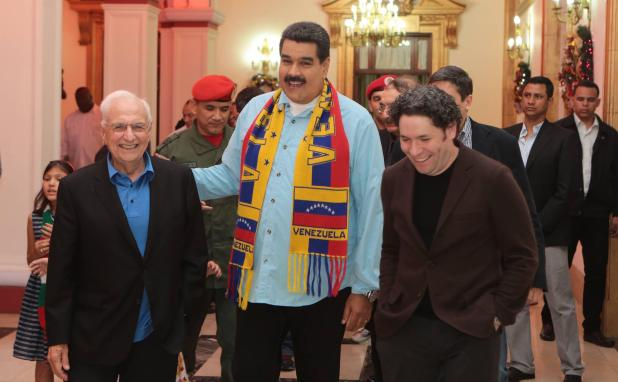
There are other elements of the announcement that deserve scrutiny. It states: “Under the disaster of Maduro’s rule, El Sistema was systematically underfunded, with budgets and programs slashed and the critical facilities project at issue abandoned partially complete.” This is both true and false. Under Maduro, most things were systematically underfunded because the economy was in pieces. But it is well known that El Sistema was a financially privileged program within the Venezuelan context, at least at its apex in Caracas, even if the provinces were starved of funds (by the program itself). Under Chávez and Maduro, it was moved closer to the centre of power and eventually to the Office of the President, where it was the apple of the government’s eye. Maduro’s right-hand woman, Delcy Rodríguez, and his son, Nicolás, were appointed to El Sistema’s board of directors, where they continue to sit, so it is very likely they will be prominently involved in handling the U.S. grant. The press release implies a break with the past management of El Sistema, but with all the same people involved as before, continuity is more evident.

Then there’s the question of the teacher training centre that will be completed. This unfinished building is a symbol of just how wrong things have gone at an institutional level with El Sistema. Since the late 1990s, the Inter-American Development Bank – El Sistema’s main overseas funder – has urged the program to decentralize, and it granted the program well over $100 million to this end, with a specific instruction to construct seven regional centres. However, these centres have never been built, for reasons that are murky, and all that the program has to show for this massive funding over many years is the incomplete white elephant in Caracas, which the IDB had never asked for in the first place. Overseas, El Sistema is treated like a resounding success; back home, this half-building exemplifies its mismanagement and distorted priorities. In a right-way-up world, the U.S. government would ask a lot more questions about the last major tranche of funding for music centres before it offered a new one. But in the world in which El Sistema has always been a black hole for funds and a propaganda tool, such questions are rarely asked by anyone.

Of course, it would be better if this centre were finished rather than sitting as an empty shell, though only time will tell whether the new funding is any more effective than the old. But the whole project, whether incomplete or complete, is misguided from the point of view of the IDB’s foundational analysis in the 1990s and 2000s, which made decentralization the top priority. In this sense, the U.S. State Department is simply doubling down on the errors that have been made over the last 30 years, pushing El Sistema further down the wrong path, exacerbating the organization’s internal imbalance, with the tab picked up by U.S. taxpayers. But since its goals are apparently political, it probably doesn’t care.

[Photo by Elsa Gonzalez on Unsplash]

Optimism, hope, or neither?

Should we be optimistic, hopeful, or neither? And does it actually matter in terms of what we do?

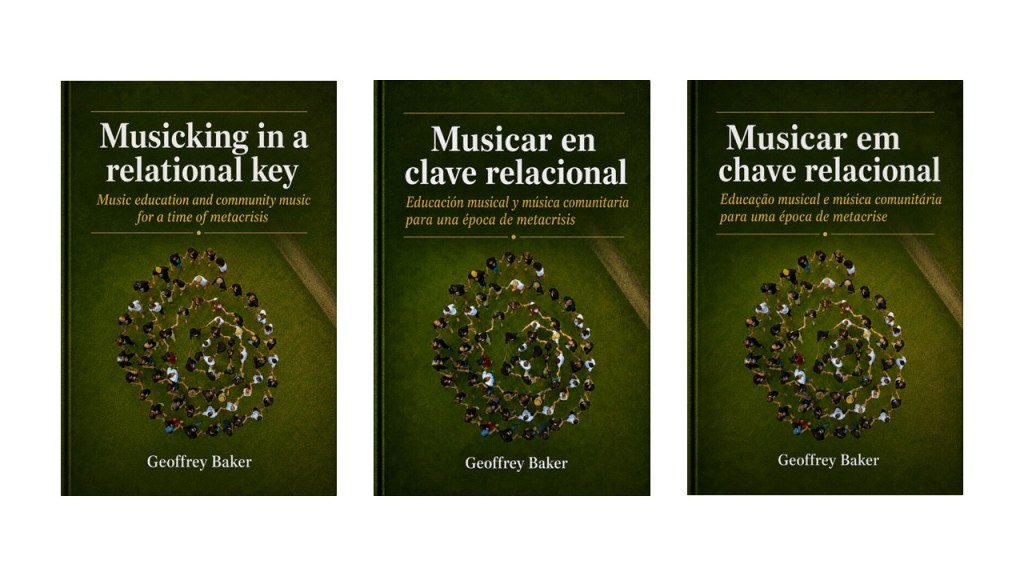
In my recent book Musicking in a Relational Key, I present its central concept in terms of optimism:

“Relational musicking and design is an optimistic credo for musicians because musicking is a meaningful action in a relational transition, and because design is something that we can all participate in.”

“A better world is possible,” insists Hartmut Rosa, one of my theoretical inspirations.

“Another way of relating is possible,” echoes Zuza Gonçalves of Música do Círculo, one of my musical lodestars.  

Referring to my employer Agrigento, I write: “When I look at the work that our partners have undertaken in recent years, at the 2026 round of Innovar projects getting underway as I write, and at the projects in the pipeline for 2027, I cannot help but feel cautiously optimistic.”

However, I am careful to qualify that optimism:

“Taking a broad view of music in Latin America, in particular of its organizations, institutions, and funding, I would argue that musicking in a relational key is a work in progress that faces substantial obstacles. There are significant challenges at the political and policy level, which are not a matter of Left or Right but rather derive from common misconceptions about music and music education that can be found across the political spectrum, not to mention in much of the music sector itself. It is currently hard to detect much appetite for change, let alone for radical transformation, at this level. Taking an even broader view, I cannot say that I am optimistic about the state of the world or that I see major breakthroughs on the immediate horizon. My optimism is more modest, and focused on the hypo- rather than hyper-level. I believe that taking action musically is worthwhile and meaningful in an interconnected world. My optimism is cautious and limited, then—but sufficient to motivate action for change.”

Alongside cautious and limited optimism, another way I define my own perspective here is micro-level optimism and macro-level pessimism. A third way would be to return to Romain Rolland’s pithy phrase, popularized by Antonio Gramsci, which has guided me in recent years: “pessimism of the intellect, optimism of the will.” The big picture is worrying, but we should not give up on trying to change things. In a relational, interconnected world, every action has the potential to reverberate more widely.

***

No sooner had I published the book than I read this quote by Vaclav Havel:

“Hope is definitely not the same thing as optimism. It is not the conviction that something will turn out well, but the certainty that something makes sense, regardless of how it turns out.”

I really like this framing, which elegantly condenses my own feelings, so perhaps I should have labelled my proposal a hopeful credo rather than an optimistic one. After all, I’m far from convinced that everything is going to turn out well, but I am pretty certain that the musical practices I describe in the book make sense whatever happens. Maybe I will make this switch in the next edition (since it is a self-published digital book, I can make a new edition whenever I like).

The only problem is… I have an ambivalent relationship with hope. Lots of thinkers and writers, like Rebecca Solnit, have argued convincingly for the importance and value of hope. And yet, the two Brazilian authors on whose work I draw extensively in my book, Vanessa Machado de Oliveira and Eliane Brum, have more critical perspectives on this issue, and they speak to me more.

In Hospicing Modernity, Machado de Oliveira argues that modernity is dying, hence it needs to be given a good death (“hospiced”) as we prepare for what comes next. She associates hope with denial; with desire for the continuation of the failing, dying system; with soft reform or “difference that makes no difference.” Instead, we need something more substantial, more radical; we must learn “to walk on a tightrope between projective (naive/delusional) hope and projective (nihilistic, hedonistic, or misanthropic) hopelessness.” In her own words, her book “is about rescuing hope from the cages of projections into the future and enabling it to weave relationships and movements in the present—the very texture that futures are made of. Whatever happens ‘then’ depends more on the quality of relationships in the ‘now’ than on the accuracy or appeal of images of the future that one projects as a way forward.”

Brum, in a chapter entitled “Hope is overrated,” writes of her disillusionment as she watches environmental, social, and cultural devastation in the Brazilian Amazon. She also tunes into young climate activists like Greta Thunberg who reject hope as facile avoidance by adults. They “seem to intuit that they must make these adults relinquish the crutch of hope, because it allows the adults to stay put on their metaphorical couches in a state of stupor while our planet-house burns.” Abandoning hope, however, does not imply inaction:

“Movement and hope, as the (extremely) young climate activists prove day after day, are not linked. It is possible to act without hope, but rather — as Anuna de Wever told me — with the joy of being together, doing together, fighting together. Her words allude to something else urgent: the need to weave the commons, to make community. Not family, clan, or nation. Community. Community is also what the new generation of climate activists is creating in the world.”

Nor does abandoning hope imply nihilism or despair:

“What fascinated me right then, and still fascinates me today, was the joy of being together, even during catastrophe. […] Joy as an act of insurrection, like a finger plunged into the eye of the hurricane, into the oppressor’s eye.” Brum marvels at “our ability to take on conflict even when we know we’re going to lose. Or fight even when the cause is lost. Act without believing. Act as an ethical imperative.”

In a similar vein is a recent article on “the obscenity of hope,” the authors of which challenge the assumption that education should instil hope in the face of the ecological crisis, and argue that hope can be a comforting illusion that distracts from the realities of the Anthropocene. They suggest that honesty, courage, ethical action, and radical creativity are more valuable than hope or optimism, given the need “to address the obscenity of the status quo.” Echoing Machado de Oliveira, they seek a path between hope and despair that leads to facing squarely the metacrisis. They call for “a ‘hope-less’ revolution” that combines “do what you can” pragmatism alongside learning about the possibility for fundamental changes. They conclude: “We can do much more than hope (or despair), we can do something, be something, and create meaning and purpose in a world that is bonkers and out of control.”

Sarah Wilson is another writer who sees collapse as somewhere between likely and inevitable. She holds up Meg Wheatley’s idea that we should strive to create “islands of sanity”: “These islands are not places where we fix the whole system. They are where we preserve human values, sanity, and coherence in small communities in advance of the chaos ahead.” For her, our job is to start working on the ideas and practices that could shape what comes next, after the terminal crisis of modernity.

What if the predictions of crisis and collapse turn out to be wrong? This seems less likely with each passing year, but Wilson argues that the sorts of changes that we might make in building islands of sanity are ones that would make our lives richer and more fulfilling anyway.

***

These various positions on optimism, hope, and hopelessness have one thing in common: they all propose active, even joyful responses to our current challenges – to the metacrisis – rather than despair and inaction. We don’t need hope to act or do something constructive. For these authors, the responses are more about preparing for what comes next rather than hoping for a solution. But in terms of what is actually done, maybe it doesn’t matter too much either way.

Focusing on relationships in the now; acting with the joy of being together and making community; pursuing honesty, courage, ethical action, and radical creativity; building islands of sanity. Do these proposals not make sense irrespective of our degree of hope or optimism about the future?

Similarly, the examples of music education and community music in my book have a value that is independent of future global trajectories. Facing up to the present metacrisis, rather than ignoring or contributing to it, these projects respond to the needs of today. They may provide models for the future, but they make sense now, regardless of how things turn out.

I think it’s important to ask what music education and community might look like in a time of societal decline, if ideas of constant growth, institutional expansion, and societal progress become untenable. How could these fields help to cultivate the relational capacities, such as listening, care, and reciprocity, that would help people to navigate a world of contraction and uncertainty?

Facing an uncertain future in which living conditions may become harsher and material and economic resources scarcer, it would make sense to invest in music education and community music that rest on the simplest technologies, such as song, movement, and body percussion, and that foreground relationality. Yet we do not need to project forwards to such a future to see the value of such musicking. It can also be a powerful response to the crisis of separation and the relational recession that we face today.

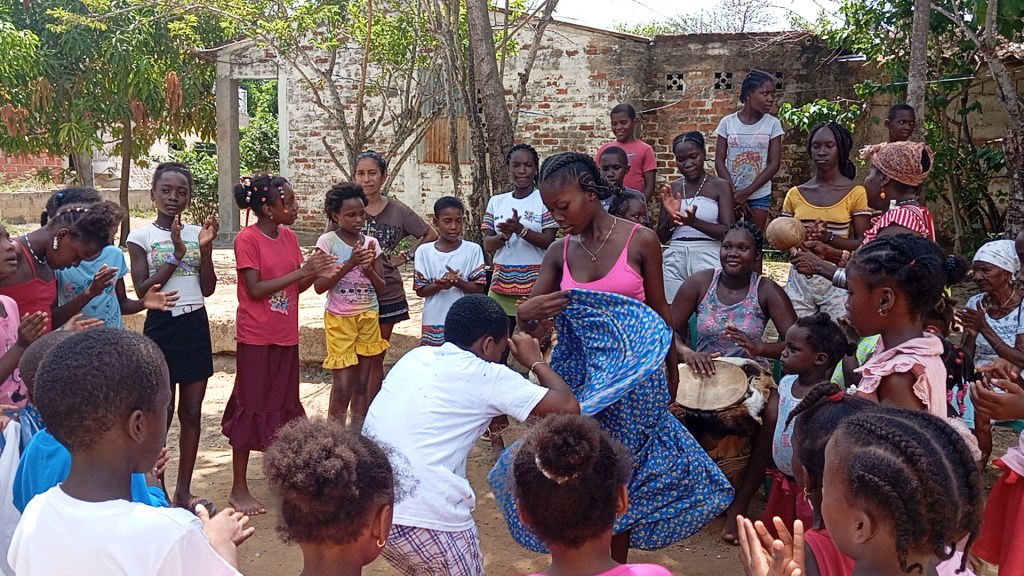
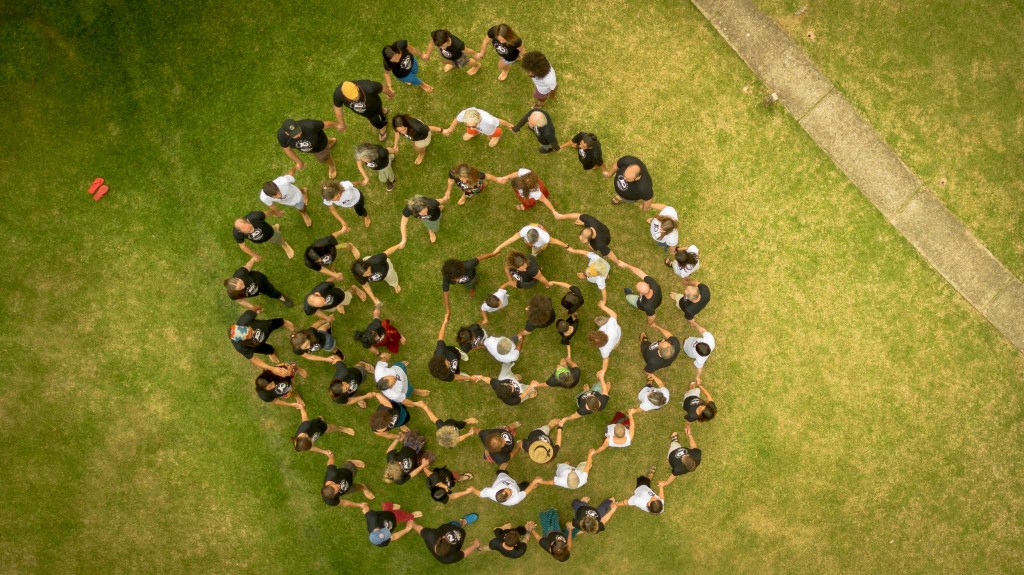
Just read the words of Fernanda Vicente in my last post. The practice she describes, Música do Círculo, draws on ancient ways of musicking and offers a model for recovering and developing those ways for a possible future of crisis and collapse. Yet, as she reveals, it may also be just what we need right now.

[Photo by Sandip Karangiya on Unsplash]

Música do Círculo: a guest post by Fernanda Vicente

I recently attended my second music retreat with Música do Círculo (circle music; MdC) in Bahia, Brazil. I wrote about my experience at the first retreat in my new book, Musicking in a Relational Key; it forms the first case study, in Chapter 3. I’m delighted to share today the perspective of another participant, Fernanda Vicente. I’m keen for other voices to be heard, and Fernanda draws on very different life experiences to mine and writes in a poetic style that I could not hope to match. I invite you to read and savour her words: they are beautiful and profound.

Fernanda Vicente is a journalist by profession, and she founded and runs Perifa Delas, a social project for women in situations of vulnerability in the Vila Pantanal favela in the city of Santos, Brazil. Prior to attending MdC, she had had no previous experience of making music; but her social project had hosted several workshops led by an MdC teacher, which had impressed Fernanda and piqued her curiosity. One of the impressive aspects of MdC is that it is designed to include everyone, from absolute beginners to experienced pros, and to enable them to make music together. The fact that someone with no background in music making could have such a deep musical-social experience in just a few days is remarkable, in my opinion, and it deserves attention from community musicians and music educators with a social orientation.

I invite you to read Fernanda’s words alongside my account of MdC in Musicking in a Relational Key, which is open access, can be read online or downloaded for free, and is available in English, Spanish, and Portuguese. I provide more contextual information and analysis; Fernanda goes straight to the heart of the matter.

Because Fernanda is a writer, I will post her original text in Portuguese below the English translation, so that those who read Portuguese can appreciate its poetry.

I arrived weary.

Not the kind of weariness that disappears after a night’s sleep, but the deeper exhaustion of someone who had to grow up too soon—someone who spent years holding the world together so it would not fall apart on everyone else.

I came carrying the weight of countless battles, my voice steady, my fists clenched, my heart quietly searching for a place where it could finally lay down its armour.

Then I found the circle. The Music of the Circle [Música do Círculo].

No one asked how many battles I had survived. No one asked how many times I had swallowed my tears so I could keep looking strong.

They simply made room. And in that simple act, there was something that felt unmistakably like home.

I sat among people who knew nothing of my story. Perhaps that is what belonging truly is—not having to explain yourself before someone draws near, not having to prove your strength before you are worthy of tenderness.

In Bahia, even the earth seemed to breathe more slowly.

The wind moved gently through the trees. The sea was endless, as all that is whole becomes sea. And every voice that rose within the circle carried an entire world inside it.

The music did not come from somewhere outside us.

It was born in the listening. In bodies willing to be fully present. In the silence between one voice and the next. In the courage to create without knowing where the moment, or one another, might lead us.

There, being part of a collective did not mean dissolving into the crowd. It meant becoming more completely yourself.

It meant offering your own voice without needing to fill every silence. It meant discovering that one person’s presence can hold another with nothing more than generosity and love.

I, who had learned far too young that survival meant fighting alone, began to understand that no struggle is meant to be carried in solitude.

There are hands that do not pull us forward; they simply walk beside us.

There are arms that do not hold us captive; they simply hold us.

There are encounters that ask nothing of us, yet quietly return the parts of ourselves we believed were gone forever.

No one in that circle imagined they could save anyone else.

Perhaps that was precisely what saved me.

For the first time in a long while, I rested without surrendering who I am.

I closed my eyes and trusted that, for a little while, others would help carry the weight of the world.

I came home changed.

Not less courageous. Not less willing to stand and fight. But knowing that even resilience needs a place to rest.

I brought Bahia back with me: the chorus of mingled voices, the scent of the earth after the wind, the memory of the sea, and the quiet certainty that belonging is not about finding people who are like us.

It is about finding people in whose presence we are free to become wholly ourselves.

Música do Círculo taught me that community does not diminish who we are. It reveals what exhaustion had hidden from our own eyes.

There, among voices, silences, and shared presence, I found again a part of myself that years of struggle had left behind.

Now I know there are encounters that do not simply pass through our lives. They settle into our bodies. They linger in our memories. They change the way we breathe.

And when the weariness returns, when the road ahead feels longer than my strength can bear, I will remember that circle.

The space that was opened for me.

Bahia, breathing slowly.

The music rising between us.

And the woman who, after so many years of carrying everyone and everything else, finally allowed herself to be carried, too.

Eu cheguei cansada.

Não daquele cansaço que uma noite de sono resolve, mas do peso de quem precisou crescer cedo demais e passou anos sustentando o mundo para que ele não desabasse sobre tanta gente.

Eu vinha de muitas lutas, com a voz firme, os punhos fechados e o coração procurando, em segredo, um lugar onde pudesse baixar a guarda.

Foi então que encontrei o círculo. A Música do Círculo.

Ninguém me perguntou quantas batalhas eu havia vencido, quantas vezes engoli o choro para continuar parecendo forte.

Abriram espaço. E naquele gesto tão simples havia uma espécie de casa.

Sentei entre pessoas que ainda não conheciam a minha história. E talvez pertencer seja isso: não precisar explicar nada para que alguém se aproxime, não precisar provar a própria força para merecer cuidado.

Na Bahia, a terra parecia respirar mais devagar.

O vento atravessava as árvores, o mar era um ( e todo um é mar ) e cada voz que surgia na roda trazia consigo um mundo inteiro.

A música não vinha de fora.

Ela nascia da escuta, dos corpos presentes, do silêncio entre uma voz e outra e da coragem de criar sem saber exatamente aonde o encontro nos levaria.

Ali, fazer coletivo não era desaparecer entre muitas pessoas. Era existir ainda mais.

Era oferecer a própria voz sem precisar ocupar todo o espaço.

Era descobrir que uma presença pode sustentar outra com afeto e generosidade.

Eu, que havia aprendido tão cedo a lutar sozinha, comecei a compreender que nenhuma luta precisa ser solitária.

Há mãos que não puxam, apenas acompanham.

Há braços que não prendem, apenas acolhem.

Há encontros que não exigem nada, mas devolvem partes de nós que pensávamos ter perdido.

Naquele círculo, ninguém tem a pretensão de salvar ninguém.

E talvez tenha sido exatamente isso que me resgatou.

Pude descansar sem abandonar quem sou.

Pude fechar os olhos e confiar que, por alguns instantes, outras pessoas sustentariam o mundo.

Voltei diferente.

Não menos forte, não menos disposta a lutar, mas sabendo que até a resistência precisa de abrigo.

Trouxe comigo a Bahia, o som das vozes misturadas, o cheiro da terra, a memória do mar e a certeza de que pertencimento não é encontrar pessoas iguais.

É encontrar pessoas diante das quais podemos existir inteiras.

A Música do Círculo me ensinou que o coletivo não apaga o que somos. Ao contrário: faz aparecer aquilo que, de tão cansadas, já não conseguíamos enxergar em nós.

Ali, entre vozes, silêncios e presenças, reencontrei uma parte de mim que a luta havia deixado para trás.

Hoje sei: há encontros que não passam. Eles permanecem no corpo, na memória e na maneira como voltamos a respirar.

E, quando o cansaço retornar, quando a luta parecer maior do que eu, vou me lembrar daquela roda.

Do espaço aberto.

Da Bahia respirando devagar.

Da música nascendo entre nós.

E da mulher que, depois de tanto tempo sustentando tanta coisa, finalmente permitiu que o coletivo também a sustentasse.

Relational publishing

As you may have noticed (!), I just self-published my new book “Musicking in a relational key” on the platform PubPub: https://musrelkey.pubpub.org/. Have you had a look? What do you think about the platform, presentation, ease of use, etc.? I’d welcome any feedback, including suggestions for improvement.

There are various reasons why I’ve gone down this route. But first, I have to acknowledge that I’m lucky that I can. I’m out of the university game so I can publish in any way I want.

I wanted to have full control over the process. My experience with Oxford University Press, which published my book on El Sistema, was positive. It was slow, but that wasn’t really anyone’s fault; it was a complex project. OUP produced a beautiful, conventional academic book. But I don’t have the translation rights, I don’t fully own the text, and I don’t have a digital version. So lots of people in Latin America have heard of the book but have never read it, because I’m not allowed to translate it and I can’t even email them a PDF in English (because I don’t have one). In short, the dissemination of the book in Latin America was severely hampered by barriers of language and cost.

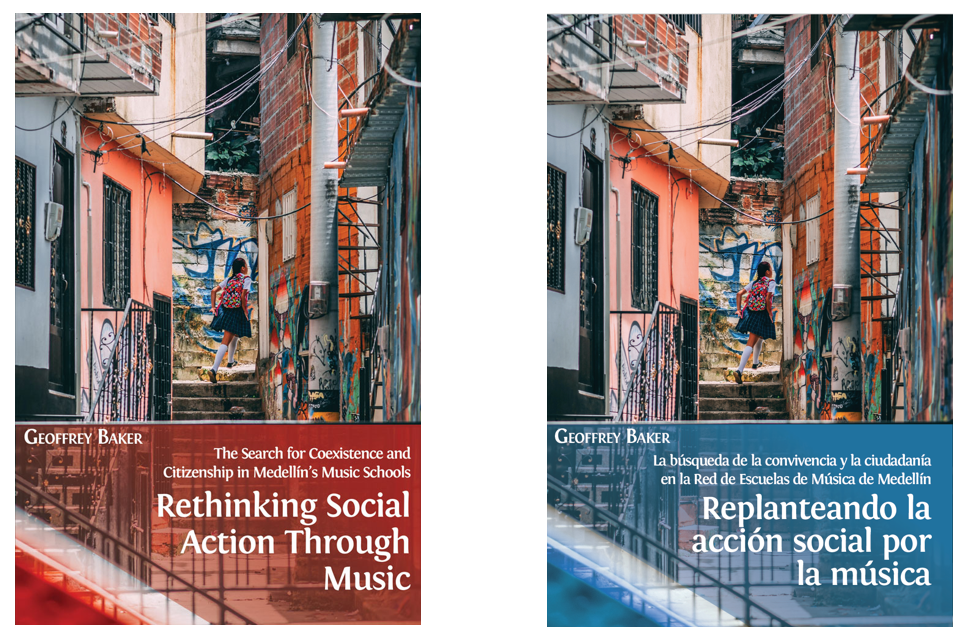
For this reason, I went down the open access route with the next book, on the Red de Escuelas de Música (Network of Music Schools) of Medellín, Colombia. This time I was able not only to make the book available for free but also to publish a Spanish translation (also free) the following year. This was a game-changer in terms of accessibility. This was also a good experience, and I would recommend Open Book Publishers to anyone interested in open access publishing. But there were cost implications for me, and some parts of the process were still rather like conventional publishing (and so a little slow and rigid for my tastes).

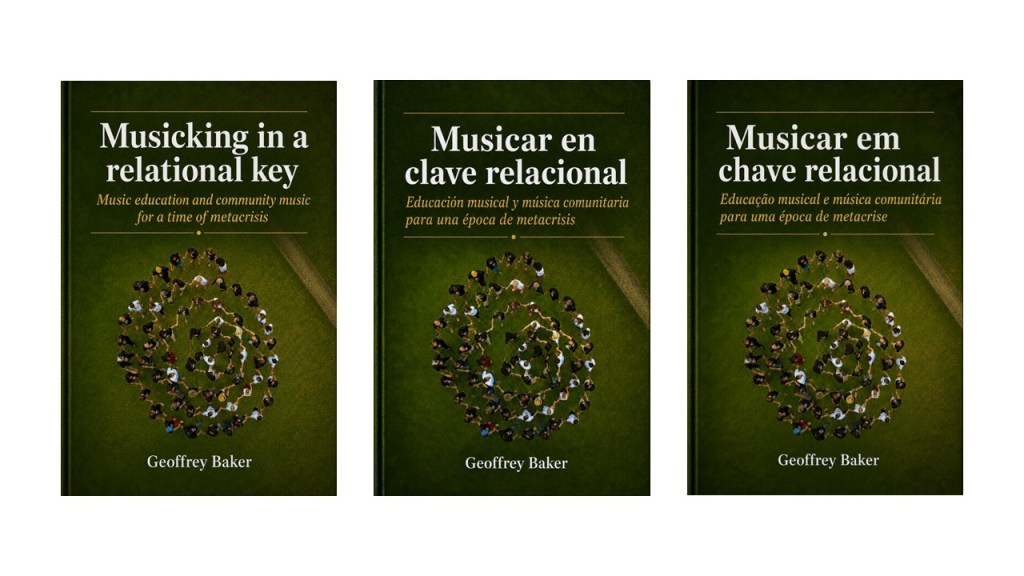
The logical conclusion for me was to go the whole way and simply publish the next book myself. This time I can not only give the book away but also release it in three languages simultaneously and retain full control over the process. Also, there is potential to move very fast if you want to. I have worked hard over the last week… but I went from finalizing the text to hitting the publish button in about 5 days. (I don’t recommend doing that, but I had various reasons I wanted to get it done fast.) And even then, I managed to correct a few minor errors during the production process. (Not the stray accent on the Spanish cover though… that was a computer glitch that I didn’t spot in time ☹)

It’s not infinitely malleable – at some point I had to close the edition and upload the final PDF version to Zenodo. I want the PDFs and online versions to align precisely, so I’m not going to tweak the online texts every time I spot a spelling error or have a new thought. But I can produce a second edition whenever I like, and depending on the feedback I get (see below!), I might do that as early as next year.

So, self-publishing online gives me maximum control over the text and its dissemination. It provides full accessibility and allows me to think of the text as something rather more fluid than a conventional book.

Another advantage is that there are more options for making the process somewhat dialogic. One thing I wanted to get away from was the idea of a book as some kind of isolated monolith. I want to be able to revise the text at a time of my choosing, and I want other people to participate in that revision. So there are discussion forums at the end of each language edition (one per language), and I warmly invite the readers (that means you!) to add comments, suggestions, critiques, questions, and so on. I’m sure I would learn from them; I might be able to respond to them; and they could potentially form part of the revision process and help to shape a second edition.

I’m sure that there are much more creative and technologically-advanced solutions than these discussion forums, but they’re a start. A lot of this kind of discussion seems to take place on social media these days, but I don’t really want that to be the central forum for everything.

My new book is all about relationality, which means giving a central role to listening, dialogue, and connection. I wanted to bring relationality into the publishing process and not just write about it. I argue in this book that taking relationality seriously implies shifts across all kinds of processes, institutions, and organizations, and that relationality starts at home. In this light, it was important for me to think about how I might publish research in ways that embody this notion, rather than merely describing it.

Perhaps it’s worth thinking about the notion of “relational publishing,” which would entail seeing publication less as a process of delivering a fixed object to readers and more as a continuous relational practice. Treating the text as a work in progress. Pursuing dialogue rather than just transmission. Seeing readers as potential participants and collaborators. Bringing the relationships that underpin knowledge creation more to the forefront. Encouraging a fluid exchange of ideas outside of commercial systems. Reducing barriers to participation as far as possible. My hope is that publishing this book on PubPub is a step in this direction.

(I’m well aware that other people have already taken bigger steps – I’m not making any claims about originality.)

I’d like to suggest that relational publishing isn’t just another label for open access. As the name suggests, the latter is largely about access. Relational publishing, though, is about participation. (There are parallels here with discussions about widening access versus participatory approaches in music education and community music, which form part of my work.)

So, if you feel moved to do so, please join in the conversation. Leave your comments and/or questions on a discussion forum, in whichever language you prefer. If you’re the first – just go for it! Or if you’d rather, you can email me at geoff@agrigentomusic.com and specify whether the comments are to be public or private. I don’t promise to respond immediately (for example, if I’m travelling), but I will read everything and reply when I can and where it seems appropriate. And everything will go into the mix that might produce a second edition or a next phase of this project or a collaborative spinoff.

This book was never intended to be the last word on anything, but rather to join in with some conversations and to kickstart some others. So please get involved.

Relational publishing needs you!

“Musicking in a Relational Key” out now!

My new book, Musicking in a relational key: music education and community music for a time of metacrisis, is now publicly available.

The book is open access and available for free download in three languages (English, Spanish, Portuguese) at https://musrelkey.pubpub.org/. It can be read online or downloaded as a formatted PDF. There are also discussion forums in the three languages, to which readers are warmly invited to contribute comments and questions.

I am launching my new book in the middle of an oppressive heatwave in the UK. My daughter is at home; her school is partially closed because its infrastructure cannot cope with the temperature and humidity. Also, it is just days after the victory of a far-right populist in the Colombian presidential election. These things are linked. Both global heating and the wave of far-right populism in many countries are rooted in a logic of separation (between groups of people, and between humans and nature) which underpins the metacrisis that humanity is currently facing. This book is about music and connection: about how music education and community music might form part of some sort of constructive response.

Musicking in a Relational Key examines these fields through the lens of relationality. Focusing on case studies from Latin America, the book argues for a relational reorientation at a time of overlapping ecological, social, and political crises. It questions the dominant model of “social action through music,” exemplified by Venezuela’s El Sistema, and proposes alternatives centred on relationality: the idea that human flourishing depends on our connections with one another and with the wider web of life.

It is through relationality that music meets the biggest challenges of our time. Music-making (or “musicking”) can help us explore and foster the connections humanity urgently needs, opening up possibilities to imagine and enact alternative ways of being, relating, and acting. Highlighting the notion of relational design, this book is a manifesto for a relational turn in music education and community music, offering a critique of the present and a hopeful contribution to building a more connected future.

And now, please read on

Breaking silence… and a new book on the way

I realize with some consternation that I have not published a blog post in a year. However, that’s not because I haven’t been writing, but rather because I’ve been writing largely in private. I sat down about a year ago to write a keynote speech, and before I knew it I had 20,000 words – far too long for the talk in question, and I felt I was still skimming the surface of the topic. So it seemed that a book had started to write itself, without any conscious intention on my part.

I’ve presented core ideas in keynotes, lectures, and papers since then, in Latin America and continental Europe, so the material has been developing. I’ve also done a bit of research in situ in Latin America. I’m now focusing on fleshing out the ideas, aiming to get a first draft finished soon.

I haven’t decided the full title of the book yet, but it is on music and relationality, and I’m toying with Musicking in a Relational Key as the main phrase.

I’m pondering publication options that will be fast, open access (i.e. free), and will allow versions in multiple languages. I haven’t made a decision yet, but I’m hoping that whatever solution I find is going to allow me to publish the book this year, hopfully towards the middle rather than the end. If you’re interested, please watch this space (despite my recent inactivity on here)…

El Sistema at 50: the rise and fall (and rise again?) of Venezuela’s controversial music programme

I recently published a feature article in Classical Music magazine entitled El Sistema at 50: the rise and fall (and rise again?) of Venezuela’s controversial music programme. You may need to register to read it, but it’s quick and free.

Below is a Spanish translation of the article.

***

El Sistema a los 50: Auge y declive (¿y resurgimiento?) del polémico programa musical venezolano

«Corrupción, abusos, propaganda: es hora de que nos lavemos las manos con El Sistema», comenzaba el artículo de Jessica Duchen en The Times a principios de enero. En The Guardian, la pianista y activista por los derechos humanos venezolana Gabriela Montero pedía a los promotores que cortaran los lazos con la Orquesta Sinfónica Simón Bolívar (OSSB), a punto de embarcarse en una gira europea: «El sector cultural no debe seguir facilitando la promoción abierta de una “Revolución Bolivariana” manifiestamente fracasada a través de la óptica emotiva de las orquestas juveniles de Venezuela». Marshall Marcus, ex director musical del Southbank Centre y antiguo empleado de El Sistema, montó una encendida defensa (también en The Guardian), instando a los músicos de la OSSB a ignorar las críticas y limitarse a tocar.

¿Cómo es posible que esta querida institución, que en su día fue aclamada por Simon Rattle como «el futuro de la música», se haya convertido en el centro de semejante controversia?

Fundada en 1975, El Sistema irrumpió en el imaginario mundial en 2007 con el debut en los Proms de Gustavo Dudamel y la Orquesta Juvenil Simón Bolívar, con sus chaquetas con la bandera y su desgarrador «Mambo». Siguió un periodo de auge extraordinario, en el que sus principales orquestas fueron agasajadas en las principales salas de conciertos y surgieron programas inspirados en El Sistema en todo el mundo. Con sus historias de transformación de las vidas de los más pobres de Venezuela, El Sistema se convirtió en un faro de esperanza para el mundo de la música clásica. Su fundador, José Antonio Abreu, fue comparado con Gandhi y Nelson Mandela y fue nominado para el Premio Nobel de la Paz.

2014 fue un año decisivo para Venezuela, donde la situación política se deterioró drásticamente, y también para El Sistema. Mientras se desarrollaba un importante brote de disturbios civiles, Dudamel y Abreu guardaron silencio, contribuyendo en cambio a las celebraciones oficiales del Día de la Juventud con un concierto de gala. Gabriela Montero respondió con una carta abierta, condenándoles por ignorar la agitación política que les rodeaba. El Sistema fue objeto de crecientes críticas. Los intentos de Dudamel de distanciarse de los acontecimientos políticos fueron calificados de «mascarada hipócrita» en El Nacional, el principal periódico de Venezuela.

En 2014 también se publicó mi libro sobre El Sistema. Especialista en música latinoamericana e inicialmente fan del programa, cambié de opinión durante un año de investigación en Venezuela, donde fui testigo de métodos autoritarios, flagrantes desigualdades de género, denuncias de abusos sexuales y muchos menos niños pobres de los que se decía. Aunque El Sistema se presentaba como un programa social, el bienestar de los alumnos y el desarrollo de la comunidad se subordinaban regularmente a los objetivos artísticos. La extraordinaria interpretación de la OSSB se basaba en unos temibles niveles de disciplina e intensidad que a veces desembocaban en la intimidación y la explotación. En contraste con la figura santa que se representaba en el extranjero, Abreu fue retratado por algunos periodistas venezolanos como un político controvertido, dominante y maquiavélico. Uno de ellos le llamó «El Ogro Filantrópico»; otro describió El Sistema como «una suerte de hermandad masculina de caballeros templarios de la música clásica, siendo Abreu el núcleo del culto».

Los partidarios de El Sistema reaccionaron mal, pero sus objeciones pronto se vieron socavadas por otras investigaciones. En 2016, Lawrence Scripp, profesor del Conservatorio de Nueva Inglaterra, y Luigi Mazzocchi, antiguo violinista de El Sistema, publicaron un artículo en VAN Magazine en el que calificaban mi relato de «acertado» y pedían importantes reformas en El Sistema. Destacando una cultura de miedo, intimidación y represalias, Mazzocchi desestimó sus pretensiones de ser un programa social: «Lo único que importa es lo bien que suena».

En 2017 se publicó una importante evaluación del Banco Interamericano de Desarrollo (BID), financiador de El Sistema. No encontró pruebas convincentes de impacto social, y solo el 17% de los alumnos procedían de familias por debajo del umbral de pobreza, en un país donde el 47% de los niños eran considerados pobres. Concluyó que El Sistema ilustraba «los retos de orientar las intervenciones hacia grupos vulnerables de niños en el contexto de un programa social voluntario». En otras palabras, El Sistema, aclamado durante mucho tiempo como modelo de inclusión social, era en realidad socialmente excluyente. Al mismo tiempo, resurgieron las evaluaciones del BID de 1997, que revelaban que veinte años antes se habían planteado serias dudas sobre los métodos de El Sistema.

Mientras tanto, la crisis política de Venezuela se agravaba. Dudamel había sido un leal servidor del gobierno durante una década; la canciller Delcy Rodríguez había escrito «¡Gracias Dudamel! Embajador de Venezuela. Llevas en alto el nombre de nuestra Patria y el ser venezolano! Orgullo nacional». Pero en 2017, después de tres años de crecientes críticas públicas, Dudamel finalmente se distanció del régimen. Con el país en graves apuros económicos, las orquestas de El Sistema dejaron de hacer giras y muchos músicos emigraron. Abreu murió en 2018, aunque no antes de que se revelaran falsas afirmaciones sobre sus calificaciones educativas.

Parecía que El Sistema había tocado fondo, pero lo peor estaba por llegar.

En 2021, la prensa se hizo eco de las acusaciones de abusos sexuales aparecidas en las redes sociales. Como informó The Washington Post, la ex alumna Angie Cantero afirmó que El Sistema «estuvo/está plagado de pedófilos, pederastas y una cantidad incalculable de personas que cometieron el delito de estupro». Detrás de su atractiva fachada, alegó, «se encuentran un montón de seres asquerosos que les encanta embaucar niñas y adolescentes, aprovechándose de su posición de poder y su renombre dentro del Sistema.» Periodistas de Venezuela, Alemania, España y Argentina siguieron el caso y aportaron pruebas. Mazzocchi, el ex violinista de El Sistema, había afirmado anteriormente que las relaciones profesor-alumno eran «la norma». Sistema Escocia y Sistema Inglaterra emitieron declaraciones públicas críticas, y algunos programas inspirados en El Sistema en el Reino Unido abandonaron cualquier referencia a El Sistema en su publicidad.

En 2022, periodistas venezolanos revelaron que el BID había prestado a El Sistema 124 millones de dólares para la construcción de siete centros regionales, pero no se había construido ni uno solo. El Sistema había fracasado rotundamente en su principal prioridad institucional de los 25 años anteriores. Una de las historias de éxito favoritas de la música clásica parecía cada vez más un mito.

Sin embargo, en 2022, Dudamel se reconcilió con el régimen venezolano y volvió a viajar a su país. Las giras volvieron a estar en juego. En 2023, Nicola Benedetti invitó a la OSSB a una residencia en el Festival de Edimburgo. Al año siguiente, la Orquesta Nacional Infantil realizó una gira por Estados Unidos, y en 2025 la OSSB volvió a Europa para celebrar su 50 aniversario. A pesar de años de escándalos y fallos documentados, la industria musical volvió a extender la alfombra roja. El Sistema sigue teniendo amigos en las altas esferas, algunos de los cuales tienen un gran interés en reconstruir su reputación: Benedetti es «Hermana Mayor» oficial de Sistema Escocia, mientras que Marshall Marcus -autor del reciente elogio publicado en The Guardian- es Presidente de Sistema Europa. El regreso de El Sistema a la escena internacional desde 2023 subraya que la organización se había entrelazado profundamente con el sector de la música clásica en sus años de auge, y muchos siguieron profundamente apegados a la historia mítica a pesar de los muchos agujeros que habían surgido.

No obstante, la polémica volvió a saltar a la palestra el mes pasado. La gira de celebración de la OSSB comenzó al día siguiente de la toma de posesión del presidente dictatorial de Venezuela, Nicolás Maduro, ampliamente acusado de haber robado las elecciones del año anterior. Hace una década, las críticas a Dudamel se referían principalmente a su pasividad y silencio. Hoy, sus acusadores sugieren algo más activo. Junto a las continuas denuncias de Gabriela Montero sobre el «lavado musical» de El Sistema, la Fundación de Derechos Humanos ha formado piquetes en los conciertos de Dudamel en Nueva York y Los Ángeles, acusando al director de «hacer propaganda descarada y dar cobertura al dictador venezolano».

Hasta ahora, el mundo de la música clásica ha prestado poca atención. Algunos han argumentado que El Sistema está separado de la política; otros, que Venezuela no es el único país con orquestas itinerantes y un gobierno cuestionable. Pero la OSSB no es simplemente una orquesta nacional, ni siquiera estatal: El Sistema es operado por la Oficina del Presidente y, por lo tanto, es una extensión directa del poder presidencial. En 2018 Maduro estrechó aún más su control, nombrando a su hijo y vicepresidente en su junta directiva. Anunció personalmente fondos para giras orquestales en el extranjero «para enamorar al mundo», dejando claras sus intenciones de poder blando. La OSSB es una orquesta de régimen, enviada en misiones políticas (como acompañar a los líderes a la ONU). Es una entidad única, que podría decirse que exige una respuesta única.

El régimen venezolano envía a la OSSB como símbolo de paz, esperanza y transformación social, mientras gobierna violentamente sobre una población desesperada que emigra en masa. Esto es lavado de arte en acción, y las críticas de los conciertos de Londres demuestran que funciona. Como escribió Rachel Halliburton en The Arts Desk: «Después de que la orquesta al completo se uniera para el resonante final […], todo el público se puso en pie para un momento que parecía tener todo que ver con la libertad y poco que ver con la dictadura».

¿Cómo queda El Sistema a los 50 años? Pocos cuestionan su éxito artístico. Ha producido muchos músicos de orquesta y ha situado a Venezuela en el mapa de la música clásica. Ha sido objeto de admiración, inspiración e imitación en todo el mundo, pero sigue siendo poco conocido. Algunos logros se han sobrevalorado, y algunas creencias comunes no resisten el escrutinio.

El enfoque de El Sistema nunca se ha estandarizado ni codificado, por lo que hablar de un «método de El Sistema» es engañoso. A pesar de las prominentes afirmaciones de que es un «programa revolucionario», hay poco de nuevo en sus prácticas o ideas educativas, que están firmemente arraigadas en los siglos XIX y XX. Aunque la OSSB ofrece un espectáculo orquestal sin igual, en términos de programación y convenciones interpretativas no está a la altura de innovadores como Manchester Collective y Paraorchestra.

Algunos admiradores apuntan a una filosofía social fundacional, pero esto también es algo así como un espejismo. El concepto de «acción social por la música» no surgió hasta la mitad de la historia de El Sistema y, como argumentó Mazzocchi, era más retórica estratégica que sustancia. Esto explicaría los decepcionantes resultados del estudio de impacto de 2017. El Sistema ha popularizado ideas como «música y cambio social» en el sector clásico, pero entre la evaluación y el deterioro de Venezuela, las pruebas del cambio real son sorprendentemente escasas. Sobre todo, como nos recordaba recientemente el artículo de Jessica Duchen, el éxito musical ha tenido un coste considerable: fallos pedagógicos, institucionales y éticos, y apropiación por parte de una dictadura con fines políticos.

El Sistema ha mostrado lo mejor y lo peor de la música clásica, y están íntimamente relacionados. En su apogeo, sus emocionantes actuaciones se basaban en una disciplina excesiva y en desequilibrios de poder que permitían que prosperaran los abusos. El violinista Mazzocchi recordaba: «Algunos profesores lo decían en voz alta: “Hago esto [mantener relaciones sexuales] con mis alumnos porque creo que les estamos ayudando a ser mejores músicos, mejores violinistas”». Del mismo modo, la enorme expansión del programa después de 2000 y su politización fueron dos caras de la misma moneda. Los presidentes Chávez y Maduro ofrecieron a El Sistema un apoyo incondicional, pero al precio de la colaboración política (acompañar a los ministros al extranjero, recibir a dignatarios extranjeros, presionar a los empleados para que votaran por el gobierno, actuar en un vídeo propagandístico, etc.). En retrospectiva, las chaquetas nacionalistas y el mambo, que maravillaron al mundo en 2007, señalaban no sólo «¡fiesta!», sino también populismo musical: la fusión de la educación musical y la demagogia autoritaria. Las semillas del declive de El Sistema estaban en su auge.

El futuro internacional de El Sistema depende de si el sector clásico está finalmente preparado para enfrentarse a esta compleja realidad o si seguirá conformándose con el mito reconfortante. Y lo que es más apremiante, ¿seguirá la industria musical abrazando al emisario cultural de una dictadura brutal? ¿O se lavará las manos, como sugiere Duchen?

En 2025 ha habido más debate público en el Reino Unido que en ningún otro momento desde 2014. Algunos periodistas han prestado más atención. Pero todavía hay líderes y escritores de la música clásica que están dispuestos a restar importancia a los problemas, ignorar la investigación y pasar de puntillas sobre las conexiones políticas de Dudamel. Hacerlo puede beneficiar a El Sistema y a sus propios feudos y legados, pero esconder los grandes fallos bajo la alfombra en última instancia no sirve ni a la educación musical ni a la cultura de la música clásica. Harían mejor en hacer caso a las alarmas que han sonado repetidamente desde la década de 1990.

Es poco probable que el mito de El Sistema desaparezca pronto: el régimen venezolano ha invertido en él, la industria musical lo considera una fórmula ganadora y una red mundial de apoyo está comprometida a mantenerlo vivo. Dudamel y otros directores de orquesta venezolanos siguen ejerciendo de influyentes animadores; el mito es una parte fundamental de su marca. Pero los días en que El Sistema parecía un futuro brillante para la música clásica han quedado atrás.

Classical music gatekeeping

There has been a lot in my social media recently about the inglorious ways that the classical music sector has historically dealt with open secrets and concrete allegations of sexual harassment and abuse. The same themes keep coming up: a focus on protecting institutional reputations; trying whenever possible to keep offending teachers in place and move students on; complicity, protection, or silence from other musicians who were well aware of the open secrets; shooting the messenger when someone goes public with their own or someone else’s allegation; threats of legal action when things get a little hot; and so on. In short, a lot of work has gone into minimizing knowledge and corrective action.

An article by Olivia Giovetti in 2023 reconsidered Blair Tindall’s Mozart in the Jungle (published in 2005) in the light of the later #MeToo movement. As Giovetti notes, responses at the time of the book’s publication were somewhat dismissive and focused particularly on delegitimizing Tindall, and as a result, important warnings about sexual abuse in classical music were largely ignored. Another dozen years passed before #MeToo brought this issue back into the spotlight.

Similarly, in 2007 Rebecca Meiser published an article in Scene on the Cleveland Orchestra concertmaster William Preucil. But naming this open secret was not enough. Preucil’s employers did not respond, other journalists did not take up the story, no one admitted wrongdoing. As Meiser writes: “Preucil remained in charge. He continued to teach at CIM and sit in the first seat at performances. To my sources — and me — it felt like we had been screaming into a pillow.” Another eleven years passed before a Washington Post investigation led to disciplinary action.

In both these cases, classical music powerbrokers – institutions and journalists – closed ranks and ignored or dismissed the story. Subsequent history showed how wrong they were. In so doing, they turned down opportunities to make classical music safer for girls and women.

***

This all rings very true from my own experience over the last 15 years. I pointed the finger at an institution, El Sistema, that had become the centre of an international “movement” and a beacon of hope for the classical music world – much bigger than a single music school. As a result, the pushback came not just from the institution itself but also from classical music gatekeepers around the world.

After I published my book on El Sistema in 2014, in which I recounted that I had heard many allegations of widespread sexual harassment and abuse during my year in Venezuela, the head of the organization told the media that my claim was “absolutely false.” That is hardly surprising, given El Sistema’s track record. But there were also prominent classical music journalists – all male, as it happens – who took to the media to trash my research, even though they knew far less about the topic than I did (only one had even been to Venezuela, and he had been on tightly-controlled media tours). They took a hatchet to it not because its claims were false but because it upset the consensus that El Sistema represented a shining success story – a consensus that these journalists had been so instrumental in creating. Academic reviews were overwhelmingly positive, so the problem wasn’t the research methods or findings: there was something else going on. Namely, classical music gatekeeping.

I had approached El Sistema as a fan, but also as a researcher searching for the truth. In Venezuela, I learned that the well-known story was a carefully-cultivated myth. But seeing responses to my book, I realized that the truth was of relatively little interest in the global North. The classical music sector had seized onto El Sistema years earlier as a symbol of a resurrection and a bright future (and as a potent fundraising tool). In this sense, the mythical story of El Sistema was extremely useful, whereas the emergence of a more accurate narrative was a big headache. So most classical music gatekeepers ignored the truth or actively tried to kill it off. They weren’t really interested in what was actually going on in Venezuela, but rather in what the myth could do for them and for classical music.

It was a tough wake-up call. I had been researching music for 18 years, but I had never published about a holy cow of the classical music industry. In my naivety, I thought that people in the field would be keen to know more, even if they found my research challenging; but it turned out that many wanted to know less, and they wanted everyone else to know less as well.

In 2014-15, then, the classical music establishment largely closed ranks around El Sistema. Between the institution’s denial and key journalists’ focus on shooting the messenger, the warnings about a culture of abuse went unheeded.

***

In 2016, VAN Magazine published an article co-authored by the New England Conservatory professor Lawrence Scripp and the former El Sistema violinist Luigi Mazzocchi. They described my account of El Sistema as “dead on” and specifically backed up my assertions about the culture of abuse. Mazzocchi affirmed that teacher-student relationships were “the norm,” and he recalled: “Some of the … teachers would actually say it out loud: ‘I do this [have sexual relationships] with my students because I think we’re actually helping them become better musicians, better violinists.’”

This time, there wasn’t even a denial from the institution or its international gatekeepers – just silence. No one batted an eyelid at a former student of El Sistema – supposedly a paragon of social justice – describing sexual abuse as “the norm.”

In 2021, Venezuela had a #MeToo moment and sexual abuse allegations against El Sistema made quite a stir. After they were published in The Washington Post, El Sistema made an official statement in which it acknowledged the problem and described legal and administrative steps that it was taking to address it. El Sistema expressed “absolute solidarity with the victims and their families.” (So much for my allegations being “absolutely false”…)

However, as I analyzed at the time, there were some discordant notes in El Sistema’s statement. Alongside the basic acknowledgment, there was a certain lack of contrition, a whiff of denial, and plenty of boasting about El Sistema’s achievements and reputation – boasts that sounded both insensitive and pretty hollow in the light of the information that came out at this time. Also, as I wrote then:

El Sistema says nothing about investigating or getting to the root of the problem. It acknowledges symptoms but makes no reference to causes, and its stout defence of its methods implies that it has little intention of probing more deeply into its own failures. For me at least, the message is clear: El Sistema will carry on largely as before, treating sexual abuse as a case of a few “bad apples” and ignoring the ways that it’s intertwined with institutional dynamics, imbalances of power, and the norms of classical music education.

At this point, then, El Sistema’s official line switched from “no, this didn’t happen” to “yes, this did happen, but only very rarely, and we dealt with it marvellously, proving once again how fabulous we are.”

***

Last month, there was controversy in the UK media over El Sistema’s ties to the dictatorial Venezuelan regime. After highly critical articles in The Guardian and The Times, the latter entitled “Corruption, abuse, propaganda — it’s time we washed our hands of El Sistema,” Marshall Marcus (former Head of Music at London’s Southbank Centre and current director of the European Union Youth Orchestra) wrote a feature article for The Guardian offering a stout defence of the Venezuelan program. The conflict of interest was glaring – Marcus is also the President of Sistema Europe and an on-off employee of El Sistema itself, so he’s essentially an El Sistema lobbyist. His article was therefore PR rather than journalism.

Marcus offered a highly selective overview of El Sistema on its 50th anniversary, but he did not avoid this thorny issue:

Reports of an oppressive regime and a boot-camp mentality in the nucleos were compounded when allegations about a specific case of sexual harassment surfaced in the spring of 2021. There was immediately the question, was this a one-off – in which case it was still extremely serious – or was it a sign of something even worse – a generalised practice and culture?

To their credit El Sistema Venezuela appear to have taken very seriously the sexual harassment allegations: they reported them to the Public Prosecutor’s office and, working with Unicef, have introduced safeguarding measures, including workshops and child-friendly kits on safeguarding for staff and students. “Every El Sistema nucleo now has an office of remediation and protection composed of people from the community,” El Sistema Venezuela’s executive director Eduardo Méndez told me. “We have connections with Unicef and other NGOs that have helped us to provide the right processes for these offices.”

This all sounds great: an allegation was raised, El Sistema responded with concrete measures, problem solved. Unsurprisingly, given Marcus’s bio, his version parrots the institutional one. But the reality, as I’ve suggested above, was more complicated and less flattering.

As reported in The Washington Post, there were two specific cases, not one – and one of the accusers claimed explicitly that her experience was part of a generalised practice and culture, and far from a one-off. The former El Sistema musician Angie Cantero alleged that El Sistema “was / is plagued by pedophiles, pederasts, and an untold number of people who have committed the crime of statutory rape.” Behind its attractive façade, she claimed, “there are a lot of disgusting people who love to deceive girls and teenagers, taking advantage of their position of power and renown within El Sistema.” Many commenters on social media backed up Cantero’s allegations, based on their own experience.

Cantero’s allegation of a generalized problem is supported by Mazzocchi’s testimony in his VAN Magazine article. I, too, had described a pervasive problem in my 2014 book. Also, in the wake of the Washington Post article, there were four published investigations of sexual abuse in El Sistema, by journalists from four countries, and all supported Cantero’s general picture.

In sum, there has long been ample evidence in the public realm to answer Marcus’s question (“was this a one-off […] or was it a sign of something even worse – a generalised practice and culture?”). Posing the question was entirely unnecessary, and leaving it unanswered, as he does, smacks of an unwarranted attempt to sow doubt about the extent of the problem and play down its significance, in a high-profile feature article in a national newspaper.

Marcus also omits to mention that El Sistema’s “very serious” response came after years of warnings and inaction. Recall that in 2014, far from taking my allegations “very seriously,” El Sistema described them as “absolutely false.” In an echo of the Blair Tindall and Rebecca Meiser cases, seven years passed before significant action was taken. The consequences of this delay were pinpointed by “Lisa,” one of the sexual abuse survivors whose testimony was central to El Sistema’s belated acknowledgement in 2021:

I wonder why they waited so long. This isn’t new. I just presented my testimonial [in 2021], but in 2014 Geoff Baker published a book where he described the structures at El Sistema that allow the abuse, and concrete cases he collected in his interviews. Baker’s book was read, in Venezuela and abroad, as an attack against El Sistema. But at that moment I was being abused in the institution. If they would have taken action then, I would have been protected, as well as other people.

As I note above, whether even the long-delayed 2021 institutional response should be considered “very serious” is highly questionable, given its boastful tone and its lack of enquiry into the culture and conditions behind the specific allegations. As the lawyer Selene Soto, who specializes in gender issues, told Caracas Chronicles: “the discussion has been focused only on the legal aspects, but an internal investigation is key. This kind of strategy delegates the protocols to entities outside El Sistema, without assuming any institutional responsibility, which is far from being the right response.”

In this light, Marcus’s article can be seen for what it is: not inquisitive journalism, but rather classical music gatekeeping.

***

So where does this leave us today? Back where we began, with the habitual responses of the classical music sector to open secrets and concrete allegations of sexual harassment and abuse. First came the denial, gatekeeping, and shooting the messenger. When the evidence became too much, there was a shift into a different mode of damage limitation, but with protecting the institution’s reputation still the priority. Acknowledge the problem but minimize it. Make no mention of earlier warnings. Make it look as though the problem is now dealt with.

Marshall Marcus’s article in The Guardian fits this mould. To the vast majority of readers, unaware of the full story, it will look like a serious and appropriate response. But in the light of the full facts, he seems to be playing down the problem and protecting El Sistema’s reputation. Hardly anyone reading his article will go away thinking that abuse is a serious problem in El Sistema or something that we need to worry about: “allegations about a specific case of sexual harassment”… “appear to have taken very seriously.” Whereas if you read my book, and the VAN article, and the Washington Post article, and the four other journalistic investigations, and the actual testimony of people involved (something that Marcus omits), it’s clear that sexual abuse IS a serious problem that goes far beyond “a specific case,” and we DO need to worry about it. After all, a pervasive issue that was largely ignored from 1975 to 2021 is hardly going to disappear overnight, particularly if there’s no sign of a thorough inquiry into the institutional culture that sustained it.

But this is not what classical music gatekeepers want you to think, and particularly not in relation to the sector’s golden goose, El Sistema. And as Marcus’s article illustrates, the media often play this role: while there have been some admirable articles that shine a light on the culture of classical music, there have been many more that muddy the waters.

Classical music’s conflicted futures

The Journal of the Royal Musical Association has just published a review essay by Jane Isabelle Forner entitled “Classical Music’s Conflicted Futures: Perspectives on the Industry and Academia from Recent Scholarship.” I recommend it to those involved with classical music performance and education, and also to those interested in social action through music (SATM), as a significant part of the essay concerns my book Rethinking Social Action Through Music and its implications for the classical music field.

There are two other books reviewed in the same essay, one of them Voices for Change in the Classical Music Profession: New Ideas for Tackling Inequalities and Exclusions, edited by Anna Bull, Christina Scharff, and Laudan Nooshin. I also highly recommend this book. The essays by Mina Yang (on Dudamel’s YOLA program) and Eleanor Ryan (on classical music teaching in Trinidad) are particularly relevant to students of SATM, but there are half-a-dozen other chapters that are also of considerable value to those working in or on this area.

El Sistema at 50: a response to Marshall Marcus

This week, the Guardian published a long article entitled “Venezuela’s Simón Bolívar Symphony Orchestra at 50: is it time for brickbats or bouquets?” Despite the title’s implication of an even-handed assessment of pros and cons, there was never any doubt which way the article was going to fall, given that it was written by Marshall Marcus, the founder and president of Sistema Europe and one of the most prominent advocates for Venezuela’s El Sistema, for which he has also worked. In the interests of balance, I will address some of the omissions and questionable statements in his article, which is better understood as El Sistema PR rather than journalism.

Marcus’s central aim is to contest the accusations (made in a separate Guardian article) that El Sistema’s touring orchestra, the Simón Bolívar, serves to art-wash the Venezuelan regime of Nicolás Maduro, now a fully-fledged dictatorship. Marcus acknowledges briefly that El Sistema “sits under the office of the president and that its board of directors includes high-profile government politicians,” but he moves on swiftly to try to undermine the argument that the orchestra has become a propaganda tool.

In hundreds of concerts within the country and across the world, I am yet to see the presence of a single government figure, apart from perhaps on one occasion in Caracas (and that was to praise El Sistema with no mention of the government). Abroad, never. If the government is trying to use Dudamel or the orchestras as puppets or henchmen, someone needs to give them the ‘how to’ handbook.

He is more sympathetic to the argument that “El Sistema is a product and symbol of the country not the government, and that it existed for several decades before the current presidential incumbent.”

First, the facts. Under Chávez and Maduro, El Sistema was moved first to the Vice-Presidency and then to the Office of the President. In 2018, Maduro’s right-hand woman (Delcy Rodríguez) and his son (Nicolás Jr) were appointed to El Sistema’s board of directors. These facts speak unequivocally to the regime’s desire to bring El Sistema under closer political control. Yes, El Sistema predates Chavismo; but the program’s current operation is unlike anything before Chavismo. Should there be any lingering doubts about the government’s soft-power intentions, they are dispelled by President Maduro’s statement in 2017 that he was assigning $9 million – in the depths of Venezuela’s economic crisis – to El Sistema’s orchestral tours “to enamour the world.” For a country’s president to announce funding for an orchestral tour is hardly an everyday occurrence.

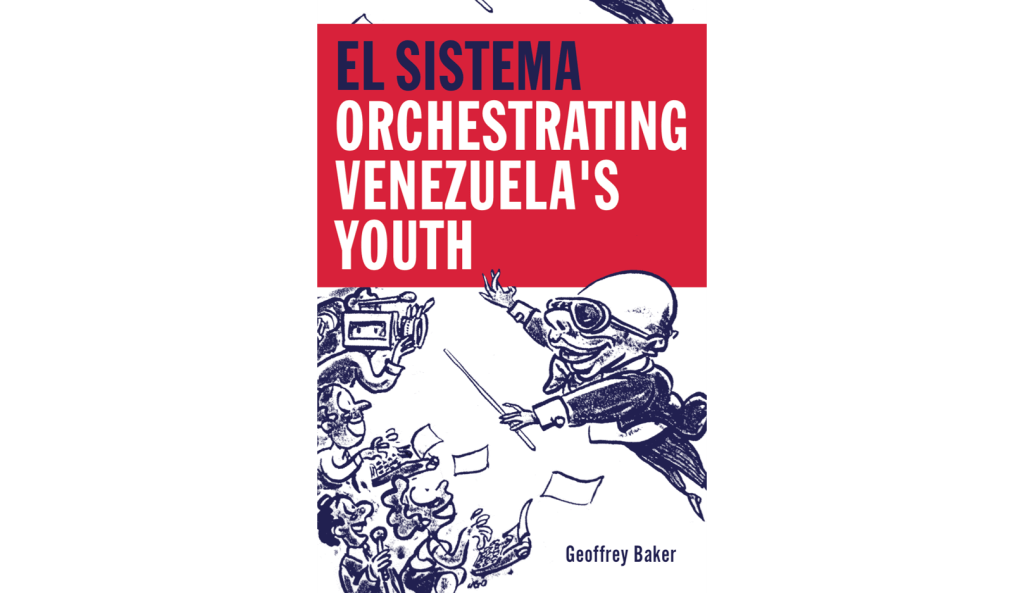
Pace Marcus, examples of government figures at concerts abound. I mentioned one, involving none other than Maduro, in my 2014 book El Sistema: Orchestrating Venezuela’s Youth, which Marcus has read:

Abreu lent his support to the government’s presentation of its record to the UN’s Human Rights Council. “‘We will demonstrate that Venezuela is a country that has managed to undergo a profound revolution to construct socialism via the path of freedom of expression, the debate of ideas, education for life and for the freedom of our people,’ affirmed the Minister for External Relations, Nicolás Maduro. These declarations were offered moments before attending the concert named ‘So That Humanity May Be Human,’ offered by the SBYO in Geneva” (“Maduro” 2011).

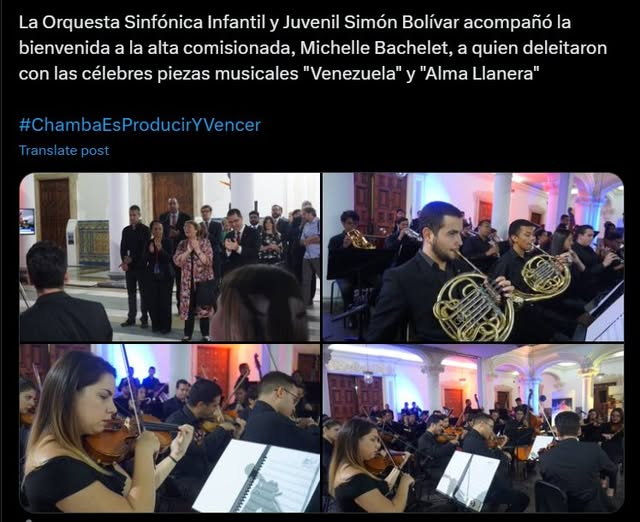
There are other examples of the Simón Bolívar orchestra accompanying political missions to the UN, for example operating alongside Delcy Rodríguez in 2016. The orchestra was wheeled out “as a sign of fraternity and Bolivarian peaceful diplomacy” to try to sway the UN’s Michelle Bachelet when she visited Venezuela to research her human rights report in 2019. It was employed in an anti-Obama propaganda video in 2015. The list could easily go on, but the point is already clear: the Venezuelan government has had the “how-to handbook” for at least 15 years and has been using it assiduously.

And the thing is, it works. Take this review of the SBSO’s first London concert:

After the full orchestra came together for the resonant ending, in which Dudamel’s movements powerfully echoed those of the timpani players, the whole audience rose to its feet for a moment that felt like everything to do with freedom and little to do with dictatorship.

This is art-washing, live, in real time. And this is why an authoritarian president pays such close attention to orchestral tours, why his regime funds them to the tune of millions of dollars. In the light of such a review, art-washing looks like a wise investment.

On this issue, El Sistema’s most prominent critic has been the pianist Gabriela Montero. Marcus notes:

Montero clearly has support, but many in Venezuela, including those critical of the government, disagree with her. Anaisa Rodriguez, for example, responded in Noticiero Digital, a well-known Venezuelan news site often critical of the government, “[Montero’s] words filled numerous people with indignation who have no links with ‘Chavismo’.”

In the interests of balance, we should also note that many in Venezuela agree with her, such as Jorge Alejandro Rodríguez, writing for Tal Cual Digital:

El Sistema, once a symbol of hope and social transformation, has become the perfect whitewashing tool for an unpresentable regime that perpetuates suffering. Dudamel, with his undisputed virtuosity, has preferred the comfort of silence to the urgency of a pronouncement. His refusal to condemn the atrocities committed by the Venezuelan regime is not neutral; it is, in fact, a position that benefits the oppressors. This ethical vacuum is magnified when compared to figures who, in similar situations, used their platform to defend universal principles.

***

Much of the rest of the article is a spirited defence of El Sistema that dances around the copious research on the topic, always aware of it, never referencing it directly, sometimes alluding to it and sometimes pointedly ignoring it. It is a dance that few readers will notice, so it’s worth examining it here.

“El Sistema is a music programme with a methodology linked to personal and social development.”

Not really. El Sistema is a music programme designed to train orchestral musicians: “to produce musicians like sausages,” in the words of one of its members. The ideas about personal and social development were added two decades later, and for strategic reasons, as I have argued in my research for a number of years. They operate primarily at the level of discourse rather than practice. The Inter-American Development Bank (IDB) evaluator Eva Estrada wrote in 1997 that musicians “perceive contradictions between the stated values and the actual practices of El Sistema,” and of the 18 that she interviewed, 14 stated that the program “contradicts their expectations of professional and personal development.” El Sistema’s methodology, if one can call it that (something disputed by the eminent Argentinean music education scholar Ana Lucía Frega, who also evaluated El Sistema in the late 1990s), involves old-school drilling in technique and repertoire.

“The fact that many of the young musicians of the orchestra seemed to come from deeply disadvantaged social backgrounds made their success all the more awe-inspiring. Here was a model for how music really changed lives.”

This is cleverly written, with the word “seemed” doing a lot of work. The average reader probably won’t even notice it – but Marcus presumably put it there because he knows that the IDB’s biggest evaluation in 2017 found that only a small minority of El Sistema students (fewer than 17%) actually came from such backgrounds. Including this fact would ruin the whole story, but omitting it altogether would be dishonest. So Marcus opts for “seemed” – a sleight of hand that allows the valuable myth of “saving kids from the slums” to continue to float in the air, but with an almost imperceptible get-out clause.

“Reports of an oppressive regime and a boot-camp mentality in the nucleos were compounded when allegations about a specific case of sexual harassment surfaced in the spring of 2021. There was immediately the question, was this a one-off – in which case it was still extremely serious – or was it a sign of something even worse – a generalised practice and culture?

To their credit El Sistema Venezuela appear to have taken very seriously the sexual harassment allegations.”

Again, it is worth stating the facts. There were two specific cases, not one – and one of the accusers claimed explicitly that her experience was part of a generalised practice and culture. As we reported in the Washington Post, the former El Sistema musician Angie Cantero posted a public story on social media, saying that El Sistema “was / is plagued by pedophiles, pederasts, and an untold number of people who have committed the crime of statutory rape.” Behind its attractive façade, she alleged, “there are a lot of disgusting people who love to deceive girls and teenagers, taking advantage of their position of power and renown within El Sistema.” Many of the commenters backed up Cantero’s allegations, based on their own experience.

Cantero’s allegation of a generalised problem is supported by the testimony of another former El Sistema musician, Luigi Mazzocchi, who affirmed in a VAN Magazine article in 2016 that teacher-student relationships were “the norm.” I, too, had described a pervasive problem in my 2014 book. There were also four published investigations of sexual abuse in El Sistema in 2021, by journalists from four countries, and all supported Cantero’s allegations. In short, there is ample evidence already in the public realm to answer Marcus’s question and therefore no justification for leaving it unanswered, which appears to be an unwarranted attempt to sow doubt.

In 2014, far from taking my allegations “very seriously,” El Sistema described them as “absolutely false.” No significant actions were taken for the next seven years. The consequences of this inaction were pinpointed by “Lisa”, one of the sexual abuse survivors whose testimony was central to El Sistema’s #MeToo moment in 2021:

I wonder why they waited so long. This isn’t new. I just presented my testimonial [in 2021], but in 2014 Geoff Baker published a book where he described the structures at El Sistema that allow the abuse, and concrete cases he collected in his interviews. Baker’s book was read, in Venezuela and abroad, as an attack against El Sistema. But at that moment I was being abused in the institution. If they would have taken action then, I would have been protected, as well as other people.

Whether even the 2021 institutional response should be considered “very serious” is a matter that I have examined previously.

In terms of El Sistema’s social impact, Marcus argues that “we should not forget the profound effect the training and methodology has had on millions of Venezuelans.” This statement is crying out for some supporting research, but instead we get one personal experience and an impressionistic view from an American previously unfamiliar with both Venezuela and El Sistema, whose opinion was formed after 10 minutes’ exposure. Neither tells us anything about the effect of El Sistema on millions of Venezuelans. For that, the best source we have is again the IDB’s 2017 evaluation, which found that, even if one squinted at the data through a particularly flattering lens, the effect appeared to be small. The researchers found no evidence that El Sistema had an effect on cognitive or prosocial skills, and taking into account their findings about the low poverty rate among El Sistema entrants, they concluded that their study “highlights the challenges of targeting interventions towards vulnerable groups of children in the context of a voluntary social program.” And this view came from El Sistema’s major non-governmental funder and supporter. Using a more robust methodology, the effect actually appears to be zero.

The article finishes by speaking directly to (and for) the orchestra’s musicians:

“in the midst of this clamour, the one voice I do not hear is that of the orchestra’s musicians. They are here in Europe to make music, to celebrate an anniversary and show what their training has done for them and their country, yet some people in the papers and on social media seem to be trying to use them as convenient puppets in a fight with the Venezuelan government.

So, as a musician, my last words go to the young Simón Bolívar musicians on stage: cut out the white noise, hold your heads up high, and show what you can do. You are yourselves. Only be that, and your concerts will be the amazing success they deserve to be.

There are two inconvenient truths here. First, the orchestra’s current musicians are kept on a very tight leash and would not be allowed to speak freely and independently to the media. Indeed, one of the criticisms that I and others have made is that El Sistema marginalizes and suppresses the voices of its members. Second, in actual fact the voices of former El Sistema musicians – now off the leash – were heard loud and clear just the previous week, in Jessica Duchen’s article on El Sistema in the Times. It’s surprising that Marcus didn’t hear them, given that it was a major article in a major newspaper and received a lot of attention due to its highly critical take. Perhaps he chose not to hear them, as their message (summarized as “corruption, abuse, propaganda”) would have blown another gaping hole in his boosterish article.

And then, what is the “white noise” that is to be cut out? Nothing other than the public debate about the role of musicians in society, and about the complex connection between El Sistema and Venezuela’s slide into dictatorship, which is much discussed at home and abroad. The longstanding questions about how artists should respond to tyranny. The kinds of questions that any thinking, ethically responsible musician ought to engage with, whatever conclusion they may ultimately draw.

Marcus is a prominent advocate for El Sistema’s “social action through music,” which proclaims loudly that it forms good citizens, yet here he proposes not only inaction but even total disengagement with discussion about civic responsibilities, rights, and actions – discussion that could not be more important or urgent right now, given current political events in Venezuela.

I recently attended the Social Impact of Making Music (SIMM) symposium in Copenhagen and saw how higher music education is grappling with how to make its work more reflective and socially engaged. It is exploring notions like “artistic citizenship” and “musicians as makers in society” in an effort to connect music education more deeply to the problems and concerns of our time. Attempting to tackle such knotty issues is the broader direction of travel among leaders and educators concerned with music’s social role, yet Marcus urges El Sistema to head in the opposite direction – away from the difficult questions and the public debate, and back to the stance of a previous era when a musician’s job was just to play the notes.

Not for the first time, El Sistema and its advocates appear remarkably out of sync with progressive tendencies in music education and with sectors like socially-engaged arts and community music, with which it shares some superficial similarities (mainly rhetorical) but few philosophical underpinnings. Indeed, El Sistema embodies the democratization of culture to which community music’s cultural democracy is a critical response. As I have argued before, El Sistema represents less a revolution in music education than a counterreformation: in the memorable words of the musicologist Robert Fink, a “visit from the ghost of public-school orchestra rooms past.”

On the basis of this article, it seems that Marshall Marcus’s faith will not be swayed by any amount of evidence – not just the corruption, abuse, and propaganda that Duchen is simply the most recent writer to detail, but also well documented problems ranging from bullying of students, to lies over founder José Antonio Abreu’s qualifications, to El Sistema’s absolute failure to achieve its primary organizational goal over the last three decades (decentralization). As a result, the vast majority of El Sistema’s “out-of-tune notes” are missing from his account. The general public, however, deserves a more accurate analysis.

Agrigento’s Innovar scheme

In 2024, Agrigento issued its first open call for proposals, as part of a new scheme entitled Innovar (“innovate” in Spanish). The aim of the scheme is to promote innovation in the field of music and social action in Latin America. For Agrigento, this was a pilot not only of an open call but also of smaller, more targeted grants. 12 projects were selected for seed-funding in 2024.

For a summary of Innovar’s first year, read on.

What does it mean to pursue social justice through music?

For the past couple of weeks, I’ve been glued to Katherine Needleman’s Facebook page. In the wake of the NY Philharmonic’s sexual assault scandal, Needleman – a top US-based oboist – has become a kind of clearing-house for testimonies of abuse in the classical music and music education sectors. (See here for my earlier reflections on the original scandal and social action through music.) The quantity of evidence is overwhelming, and Needleman is not even publishing everything she receives – and what she receives is undoubtedly the tip of an iceberg. It makes for grim but necessary reading for anyone with a serious interest in this field from a social perspective.

Only a small minority of classical musicians are sexual predators or harassers, so how big really is this problem? The way I see it, on the basis of what I’m reading but also my own research over many years, is that there are three concentric circles: in the middle, an inner circle of sexual predation and harassment. Around it, a wider culture of abuse of various kinds (bullying, shouting, belittling, ostracism, etc.), of which the inner circle is a subset. Both are manifestations of abuse of power. And around them lies an outer circle: the “culture of complicity” (about which I wrote in my previous post). Many of those in the outer circle may be good people in many ways; some individuals may even resist what takes place in the inner two circles. But for such issues to be so pervasive for so long, the culture as a whole has to play along: conservatoires sweep complaints under the rug so as not to upset famous teachers; festivals invite known sexual predators because they bring in audiences; young women are advised not to spend time alone with male musicians known to be “handsy,” rather anything being done about the offending behaviour; open secrets sit there for decades without influential figures resolving to tackle them; erratic, unprofessional, or authoritarian behaviour is treated as an excusable side effect of great artistry.

Audiences form part of this culture of complicity. If they boycotted concerts featuring known predators, change would happen pretty quickly. Not doing so confirms the sector’s unwritten rule: all that matters is how good it sounds.

A lot of the discussion on Needleman’s page has been, indirectly, about the culture of complicity. Men are particularly implicated, of course: all those who stand by and passively accept or play along with the misogynistic culture, whether or not they are actively involved themselves. But it seems that plenty of women, too, have played a part, for example taking a “well, I’ve never experienced sexual harassment” line, rather than supporting the many who have and seeking change. When we take this culture of complicity into account, and not just the perpetrators, the problem looks very big.

***

What does it mean to pursue social justice through music – or more precisely, through orchestral music? For El Sistema and the international field that has built up around it, the answer is: to give socio-economically disadvantaged youths access to the orchestral world, via education or training. Access is the key word here.

The problem here is not hard to spot. How does it constitute social justice to give young people access to a world that is riddled with injustices? How are these young people going to fare in a system marked by extreme power imbalances and resultant abuses? If the system stays the same and just the faces change, how much justice is really enacted?

There is no reason to think that the gender injustices that are legion in this field are going to be reduced by a shift in socio-economic representation. Just look at El Sistema, where widening access has gone hand in hand with stark gender inequity and pervasive sexual abuse and harassment.

If the orchestral sector is serious about pursuing social justice, it ought to start by turning its gaze inward and putting its own house in order. The idea that orchestras provide a model for society and a school for citizenship looks untenable in the cold light of the testimonies of the last two weeks, and the fact that it has got so much traction speaks volumes about the sector’s willingness to overlook jarring contradictions. How could an organization that systematically marginalizes women be held up as a model of social inclusion for the world? How could a culture of complicity wrapped round a culture of abuse be considered an engine of social justice?

The first step to pursuing social justice through music is to pursue social justice in music. To acknowledge that the music sector has a big problem, and to determine to do something about it. Katherine Needleman (and those supporting her, like Lara St John and Anne Midgette) is showing what this looks like. It’s not about airy statements about the power of music. It’s not about generating marketing copy and boosting your brand. It’s about sticking your neck out and telling uncomfortable truths. It’s about challenging the culture of complicity, not reinforcing it by idealizing the orchestra as a “model for society.” It’s about this quote from John Lewis, with a big h/t to another inspiring musical figure, André de Quadros:

Rosa Parks inspired us to get in trouble. And I’ve been getting in trouble ever since. She inspired us to find a way, to get in the way, to get in what I call good trouble, necessary trouble… if you see something that is not right, not fair, not just, do something. We cannot afford to be quiet.

Here’s to Katherine Needleman and all those who are causing good trouble, necessary trouble.