My new book, Musicking in a relational key: music education and community music for a time of metacrisis, is now publicly available.
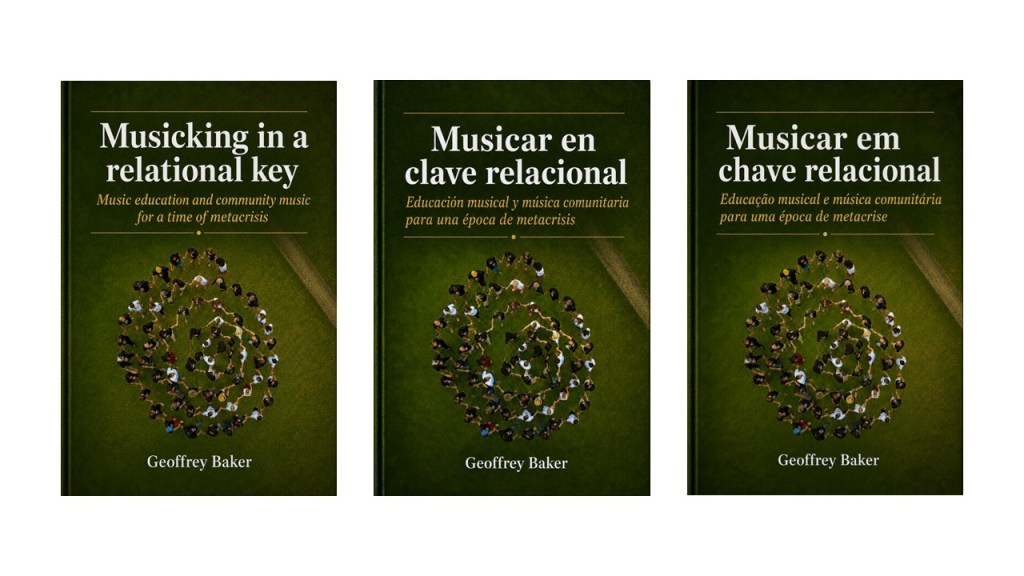
The book is open access and available for free download in three languages (English, Spanish, Portuguese) at https://musrelkey.pubpub.org/. It can be read online or downloaded as a formatted PDF. There are also discussion forums in the three languages, to which readers are warmly invited to contribute comments and questions.
I am launching my new book in the middle of an oppressive heatwave in the UK. My daughter is at home; her school is partially closed because its infrastructure cannot cope with the temperature and humidity. Also, it is just days after the victory of a far-right populist in the Colombian presidential election. These things are linked. Both global heating and the wave of far-right populism in many countries are rooted in a logic of separation (between groups of people, and between humans and nature) which underpins the metacrisis that humanity is currently facing. This book is about music and connection: about how music education and community music might form part of some sort of constructive response.
Musicking in a Relational Key examines these fields through the lens of relationality. Focusing on case studies from Latin America, the book argues for a relational reorientation at a time of overlapping ecological, social, and political crises. It questions the dominant model of “social action through music,” exemplified by Venezuela’s El Sistema, and proposes alternatives centred on relationality: the idea that human flourishing depends on our connections with one another and with the wider web of life.
It is through relationality that music meets the biggest challenges of our time. Music-making (or “musicking”) can help us explore and foster the connections humanity urgently needs, opening up possibilities to imagine and enact alternative ways of being, relating, and acting. Highlighting the notion of relational design, this book is a manifesto for a relational turn in music education and community music, offering a critique of the present and a hopeful contribution to building a more connected future.
And now, please read on…

